NPI · Design for Testability · Production Test
Why Late PCB Test-Point Decisions Slow Down Pilot Builds
A PCB can be electrically correct and still be unready for pilot if the access needed for repeatable production test and fault isolation has not been closed.
Abstract
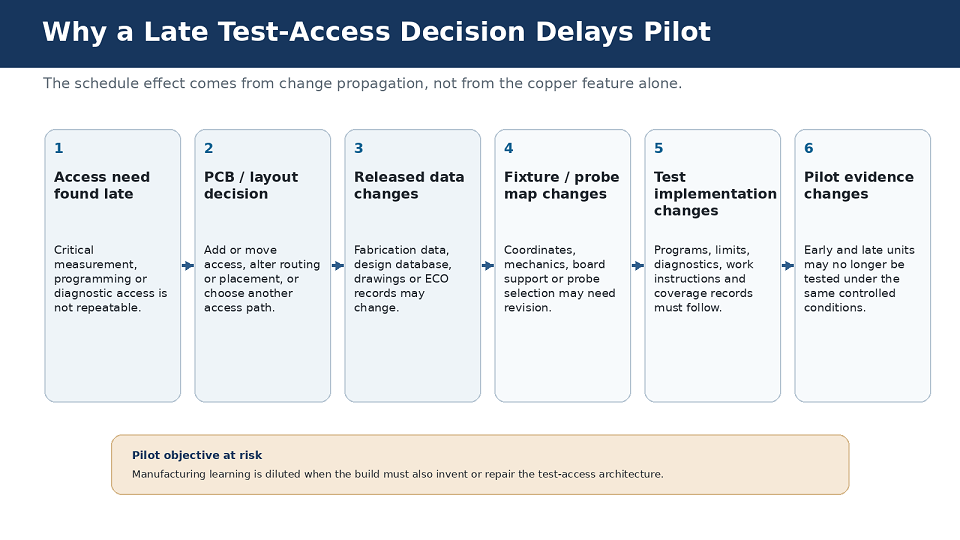
Late PCB test-point decisions do more than make testing inconvenient. When required test access is discovered after placement, routing, fabrication release or fixture planning, the resulting decision can propagate through PCB data, fixture coordinates, test software, controlled documentation and pilot revalidation. The build then spends time resolving access dependencies instead of learning whether the manufacturing process is repeatable.
This article focuses specifically on that release-readiness problem: what test access should be defined before pilot, what evidence demonstrates that the access is usable, and how OEM and EMS teams can disposition residual access risk without turning the pilot into a test-development exercise.
Executive Summary
A common assumption is that test points can be finalized after a prototype works. That can be acceptable when the intended manufacturing test and debug strategy already has adequate physical or digital access. It becomes risky when the pilot is the first time the team discovers that a required rail, programming interface, reset condition or communication node cannot be reached repeatably.
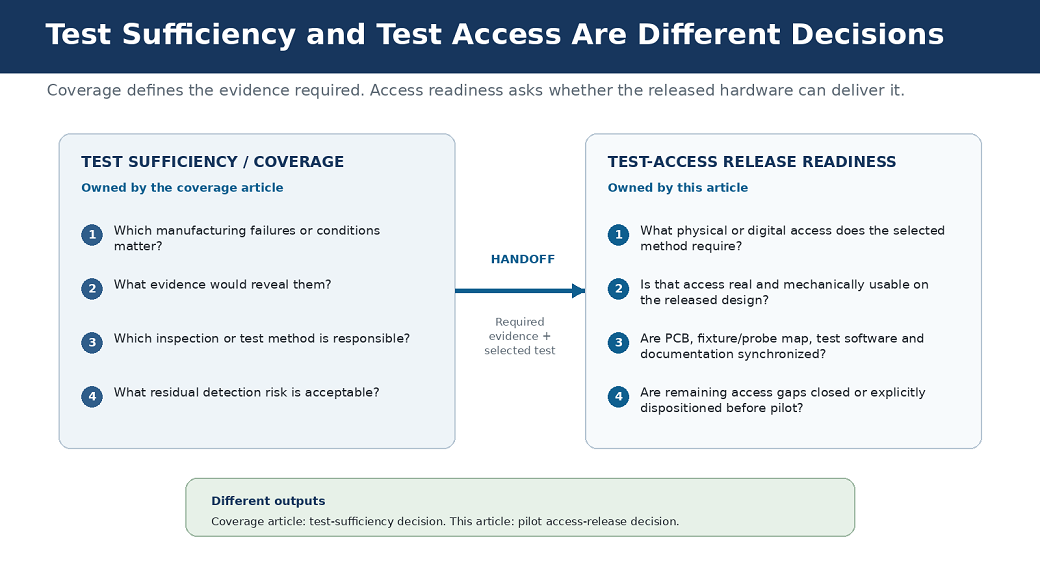
This article deliberately addresses a different question from test-coverage sufficiency. The test-coverage article asks what failures must be detected, what evidence is sufficient and which inspection or test method should own that evidence. This article starts after that decision:
Can the released hardware, fixture concept and controlled test infrastructure actually provide the required access before pilot begins?
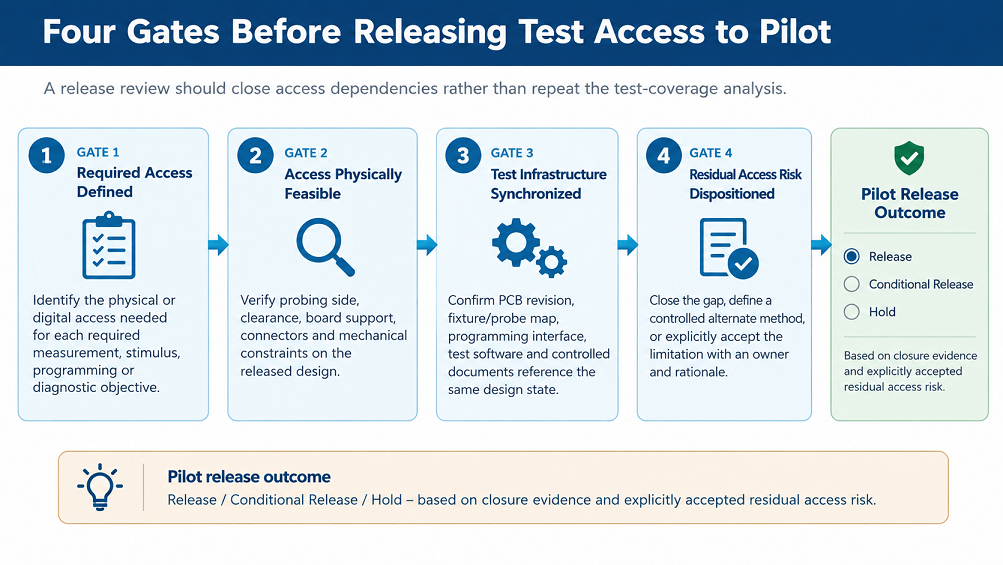
The release decision is therefore not based on test-point count. It is based on closure evidence: required access is defined, physically feasible, synchronized with the correct PCB and test revision, and any remaining access limitation has an explicit disposition.
Why Do Late Test-Point Decisions Slow Down a Pilot Build?
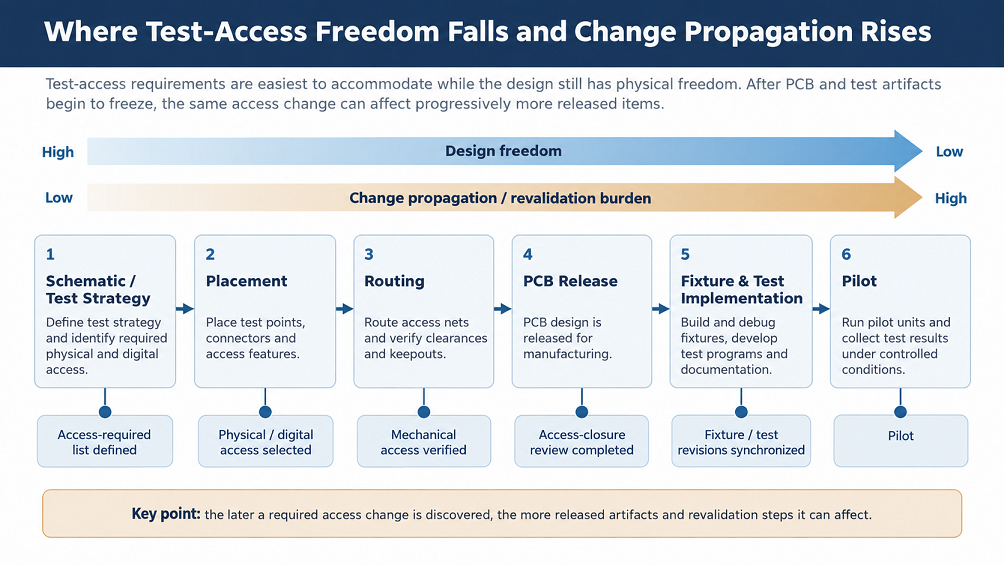
Because test access is a physical and configuration-dependent design dependency. When the requirement is discovered after PCB and test artifacts have started to harden, a small access change can force coordinated changes across multiple released or partially released items.
A power rail, reset line, programming signal or communication node may look like one schematic requirement. In production, however, the access path has to coexist with component placement, routing, probe approach, board support, fixture mechanics, programming interfaces and the selected test sequence. Once those dependencies exist, moving or adding access is no longer a local edit.
Siemens' DFT guidance recommends moving testability consideration into schematic and PCB design rather than waiting until layout is complete. Cadence likewise notes that in-circuit-test capability has to be designed into PCB layout rather than treated as an activity that begins after the board is finished.
IPC-2231A, DFX Guidelines, provides a broader DFX process framework for printed-board assemblies and includes a dedicated Testability section covering concept design, detailed design, design release and DFT assessment. It does not prescribe the four-gate method used in this article, but its structure reinforces the underlying principle: testability is a design-review concern that should mature with the product rather than being deferred until production.
A Pilot Build Should Produce Manufacturing Evidence, Not Invent the Test Architecture
A pilot build is useful because it exposes the interaction between the released design and the intended production system: material, assembly process, programming, inspection, test, handling, documentation and operator execution. It is a controlled opportunity to learn what is repeatable before ramp.
That learning becomes harder to interpret when the test-access method changes during the same build. If one unit is checked through a manual probe, another through a temporary connector, and later units after a PCB or fixture change, the resulting failure history contains two variables: manufacturing variation and test-system variation.
Engineers can still learn from such a build, but attribution becomes harder. A failure may have changed because the manufacturing process changed, because the product revision changed, because the test method changed, or because all three changed together.
This is consistent with Indic's broader guidance on EMS transfer readiness before pilot. That discussion treats test readiness as one part of the complete transfer package. The scope here is narrower: closing the access dependencies that could otherwise consume the pilot itself.