EMS Transfer Readiness for High-Mix Industrial Electronics
By: Gopikrishna Mamidipudi : Business Development, LinkedIn: https://www.linkedin.com/in/gopykryshna/ Reviewed by: Ayush Khanna : Director of Engineering, LinkedIn: https://www.linkedin.com/in/akhanna4/
EMS Manufacturing Transfer Readiness for High-Mix Industrial Electronics: 8 Things to Finalize Before Pilot Build
A product transfer to an EMS partner goes wrong when the OEM treats it like a file release instead of a manufacturing-readiness event. The same is true whether you are placing your product with a contract manufacturer for the first time or moving an established product from one EMS partner to another — the readiness work is identical, and the consequences of skipping it are identical too.
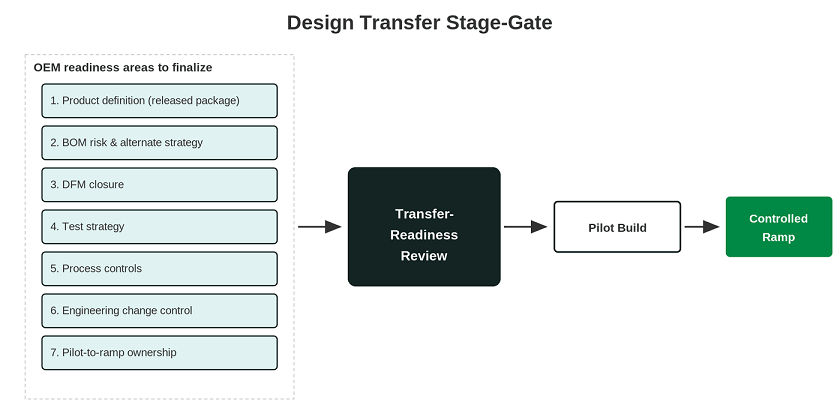
Bottom line : before transferring a product to an EMS partner for high-mix industrial electronics, OEM teams should finalize eight things — released product definition, BOM risk and alternate strategy, DFM closure, test strategy, process controls, engineering change control, quality and acceptance criteria, and pilot-to-ramp ownership. If any of those are still vague, the transfer is early, and pilot build will absorb the cost.
The product may be technically working and the transfer still fails — because the BOM is unstable, the test strategy is incomplete, revision control is loose, or open engineering
decisions get pushed onto the EMS team during pilot. In high-mix industrial electronics, that mistake gets expensive fast.
Why Product Transfer to an EMS Partner Is Harder in High-Mix Industrial Electronics
High-mix industrial programs are less forgiving than standard repeat-build products. They usually involve some combination of multiple variants, uneven volumes, long product-life expectations, harsher operating environments, tighter traceability requirements, and more engineering exceptions during ramp. In that environment, a weak transfer creates recurring instability rather than a minor documentation problem:
- Wrong revisions reaching the floor
- Kit shortages caused by fragile BOM assumptions
- Fixture delays because test intent was never fully defined
- Rework loops caused by unclear workmanship criteria
- Engineering change traffic that overwhelms pilot builds
The deciding factor isn’t whether the EMS partner is capable. It’s whether the OEM has converted product knowledge into production-ready decisions.
Eight Things to Finalize Before EMS Transfer
Finalize the product in a way that removes avoidable interpretation from manufacturing — lock the decisions that affect buildability, sourcing, test, quality, and engineering response in released form, not in discussion threads or tribal knowledge.
1. Freeze the Product Definition Before EMS Transfer
The product definition has to be stable enough that manufacturing isn’t guessing what the latest truth is. The released package should cover:
- Released BOM
- Released gerbers and fabrication data
- Assembly drawings
- Pick-and-place data
- Approved schematics
- Firmware version and programming method
- Mechanical revision alignment
- Labeling and serialization requirements
- Variant logic and configuration rules
What usually goes wrong isn’t a missing file — it’s mismatch between files. A board revision changes but the assembly note doesn’t. A firmware dependency exists but programming steps aren’t documented. A connector orientation issue is known internally but never captured in the released package. If the EMS team is discovering these gaps during NPI handoff, the OEM hasn’t finished the transfer package.
2. Prepare the BOM for Risk, Not Just Correctness
A BOM that’s electrically valid isn’t automatically ready for transfer. In high-mix industrial electronics, BOM readiness is about risk: lifecycle, exposure, alternates, and substitution boundaries.
- Approved manufacturer part numbers, not just internal descriptions
- Lifecycle status for critical parts
- PCN exposure reviewed for critical components
- EOL and last-time-buy risk identified
- Long-lead and allocation-risk parts flagged early
- NCNR exposure understood before material commitment
- Approved alternates where appropriate
- Alternate package, fit, thermal, and performance implications reviewed
- Alternate validation boundaries agreed before release
- Customer-approved versus engineer-approved substitution boundaries
- Storage, handling, or moisture-sensitive requirements
Many “supply chain issues” are unfinished product engineering decisions. If a part goes constrained and no alternate strategy exists, that isn’t only a procurement problem. If an alternate changes fit, thermal behavior, or test response, that isn’t only a buyer problem. If PCN exposure, EOL planning, or NCNR risk gets ignored until purchase orders are placed, sourcing risk has already become a transfer problem.
A 3-wheeler EV charger program faced an ARAI certification window the original BOM couldn’t realistically meet. The assembly depended on imported subcomponents whose lead times sat outside the deadline, and the customer’s prior build cycle was around two weeks. Treated as a procurement problem alone, the program would have absorbed substitution and revalidation risk during pilot.
Indic took a different route. Sourcing and engineering reviewed the BOM together, identified the import-dependent content as the binding constraint, and localized critical parts before pilot — validating alternates against spec rather than letting them be discovered during build. With PFC top-and-bottom SMT parallelized and box-build started before all boards were complete, the assembly cycle came down to four days in time for ARAI evidence. The four-day number matters less than what it proves: the sourcing risk was closed inside engineering, not pushed onto the pilot floor.
3. Close DFM Decisions Before NPI Handoff to the EMS Floor
DFM shouldn’t begin after the product reaches the factory. By transfer time, the OEM and EMS teams should already have reviewed the design for issues that affect yield, takt time, inspection difficulty, or rework exposure:
- Fine-pitch and low-standoff placement risk
- Pad design and solderability concerns
- Connector accessibility
- Depanelization method
- Board support requirements
- Selective solder or manual solder content
- Conformal coating constraints
- Mechanical stack-up with enclosure, cabling, or fastening
- Serviceability or repair limitations
In high-mix products these issues matter more because repeated manual exceptions destroy scalability. A build can work during prototype and still be unfit for controlled industrialization.
A dense IoT module — boards with 0.3 mm pitch components, multiple BGAs per board, and shielded packages — looked complete on paper. The pre-pilot DFM review caught three buildability risks that would otherwise have surfaced as yield loss during ramp. Solder-paste behaviour on the fine pitches was unstable until the stencil was redesigned around a Type 5 paste, a support block added under the assembly, and aperture and rheology parameters tuned together. Component placement was shifting on specific package types until pick-and-place was retuned, special nozzles introduced, and a jig tolerance closed. Depaneling was damaging assembled boards until router-bit selection was matched to the revision and a fixture with cushioning replaced the original support.
None of those were design flaws the OEM should have caught. Each was a buildability question the line would otherwise have learned through scrap — which is the difference between a product that can be assembled and one that can be industrialized.
4. Finalize the Test Strategy Before the Product Reaches the EMS Floor
If test strategy is still vague at transfer, the pilot build becomes a debugging exercise. Define:
- What must be tested at board, subassembly, and final-unit level
- Pass/fail criteria
- Programming flow
- Calibration flow
- Test-point access assumptions
- Fixture ownership and timeline
- Diagnostic depth required
- Operator dependency limits
- Traceability data capture
- Retest rules
- Golden sample availability
- Required test coverage expectations and how adequacy will be reviewed
Too many teams say “functional test will cover it” without defining what that actually means. That’s how fixture redesign, missing access, weak fault coverage, and escaped failures show up later. The right question isn’t whether a test exists; it’s whether coverage is good enough for the product’s real failure modes, service risk, and field consequence. A serious EMS test stack — ICT, fixture-less Flying Probe for low-volume and NPI work, functional test (typically automated in LabVIEW or Python), on-board programming, end-of-line, hi-pot, and reliability screening, all bound to the serial through the MES — gives the OEM the levers to make that decision before the line is committed.
A smart-city street-lighting customer transferred a four-board PCBA module to manufacturing with no test specifications — only Gerbers and a BOM. An outsourced MDA pass capped near 50% coverage, which would have meant either committing a custom fixture chasing the gap or shipping with weak fault isolation. Neither was acceptable for an industrial product expected to sit in service for years.
Indic rebuilt the test strategy before any fixture investment. Flying Probe Testing came in-house with dynamic probe access across multiple nodes, removing the need for a custom bed-of-nails on a board whose access wasn’t fully characterised. Coverage rose to 97.78%, reaching detection ranges the earlier approach couldn’t. The decision saved fixture spend that would have been built against an incomplete test plan — and produced a coverage number the OEM could actually defend in field-failure analysis.
5. Make Process Controls Explicit in the Transfer Package
Anything process-sensitive belongs in the release package or transfer notes. A capable EMS partner can execute controlled processes, but it can’t infer hidden intent reliably — and in industrial electronics, where products face vibration, dust, thermal cycling, or electrical noise in the field, the unstated controls are usually the ones that matter:
- Torque limits
- Adhesive type and cure conditions
- Cleaning restrictions
- ESD sensitivity beyond standard handling
- Bake requirements
- Conformal coating boundaries
- Calibration handling
- Potting or sealing controls
- Programming sequence dependencies
- Packaging and transit protection for sensitive assemblies
These controls only mean something when the receiving floor is set up to honor them — an ANSI/ESD S20.20-compliant ESD-safe production environment, nitrogen-atmosphere reflow for solder-joint integrity, documented coating and bake regimes. Confirm that the partner you’re transferring to runs the infrastructure that makes your process controls real, not just acknowledged.
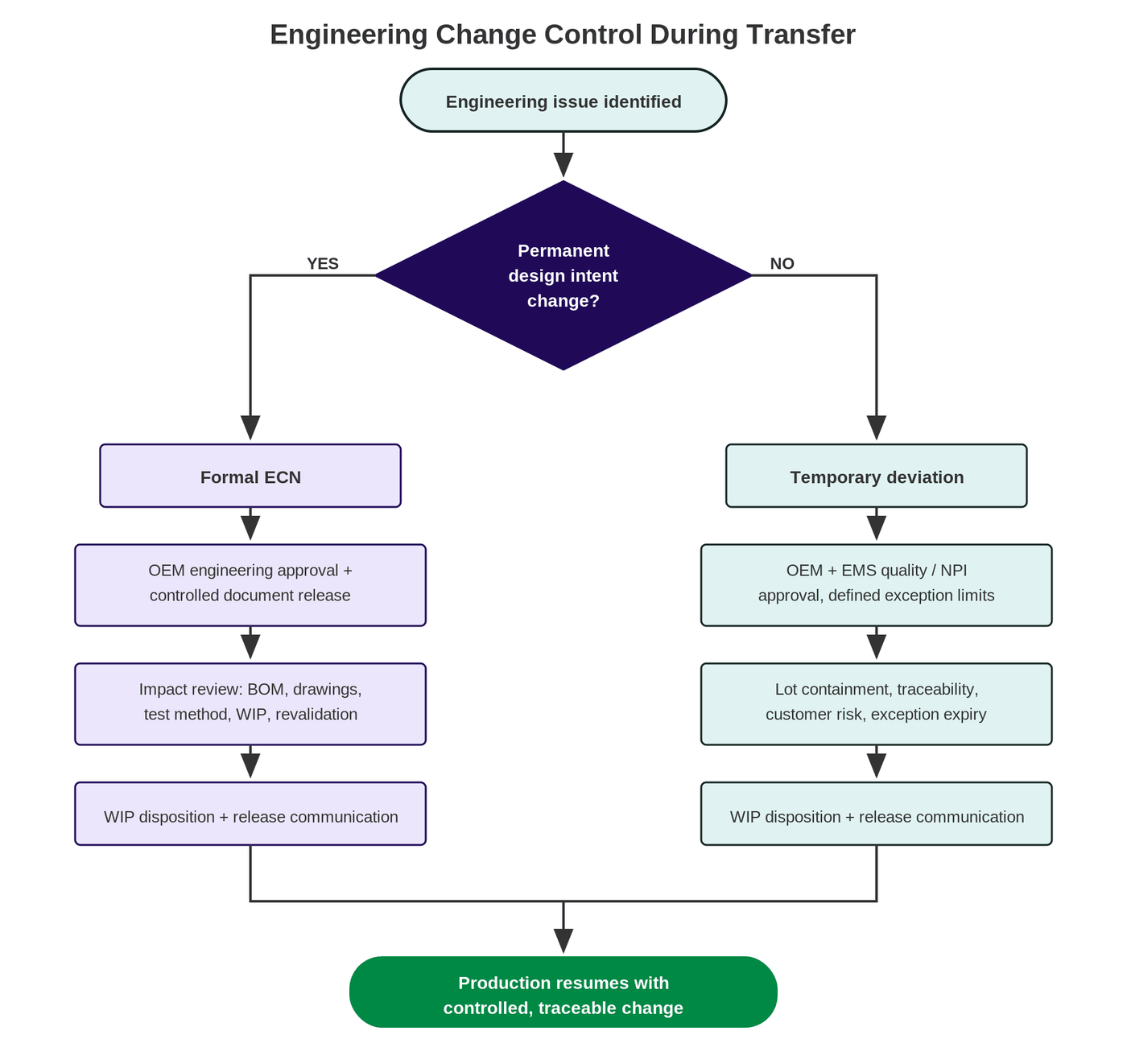
6. Set Up Engineering Change Control Before Transfer Begins
Change control has to be decided before changes start flying. Define:
- What counts as a formal engineering change
- What can be handled as a temporary deviation
- Who approves substitutions
- How revision status is communicated
- What documents must be re-released
- How work-in-progress is treated when a change lands mid-build
- Whether pilot and production revisions can coexist temporarily
- What revalidation is required after a change
This isn’t paperwork for its own sake — it’s commercial protection. Weak change control creates scrap, mixed-build risk, traceability confusion, and finger-pointing during pilot.
A Battery Management System PCBA in production for an automotive customer was running at roughly 5,000 PPM due to a flash-memory failure mode on one IC. The component supplier refused to engage without access to the customer’s source code, which was not on the table. The defect mode was real, the field consequence was significant, and the natural temptation was to keep shipping while a structural fix was negotiated.
The change was handled formally instead. Cross-team trials ruled out assembly-side root causes; the software team produced a firmware revision that fixed the flash path; and the revision was cut in as a controlled engineering change, with WIP and finished goods quarantined and reviewed under disposition rather than mixed into ongoing builds. Post-revision shipments closed to 0 PPM, and the quarantine WIP space was recovered for normal production flow. The mid-program change didn’t slip the line or create a parallel inventory problem — because the change-control discipline was operational before the change arrived, not assembled around it.
7. Lock Quality and Acceptance Criteria Before EMS Transfer
Vague quality language guarantees conflict. Lock the criteria up front:
- Workmanship standards
- Cosmetic acceptance rules
- IPC class expectations where relevant
- Inspection points
- Defect severity thresholds
- Rework acceptance rules
- Reliability-critical characteristics
- Sampling versus 100% inspection logic
- Outgoing quality expectations
- Documentation needed for traceability or audits
The strongest anchor in this section is the workmanship-and-acceptance standard. For industrial electronics, that typically means building to IPC-A-610 Class 2 — with Class 3 capability for high-reliability or safety-critical programs — and naming the class on the released package so the inspector and the customer are reading from the same rulebook. A transfer is stronger when the EMS partner doesn’t have to reverse-engineer the OEM’s quality philosophy.
8. Name Ramp-Readiness Owners After NPI Handoff to the EMS Partner
A transfer package doesn’t run a transfer — people do. Ramp readiness needs named owners and a defined operating rhythm across:
- OEM technical decision-making
- EMS NPI coordination
- Sourcing escalation
- Test readiness
- Quality escalation
- Change approval
- Pilot-build review
- Ramp go/no-go decision
If a pilot build exposes five serious issues in one day, everyone needs to know who decides what happens next. If the answer is unclear, the transfer isn’t ready.
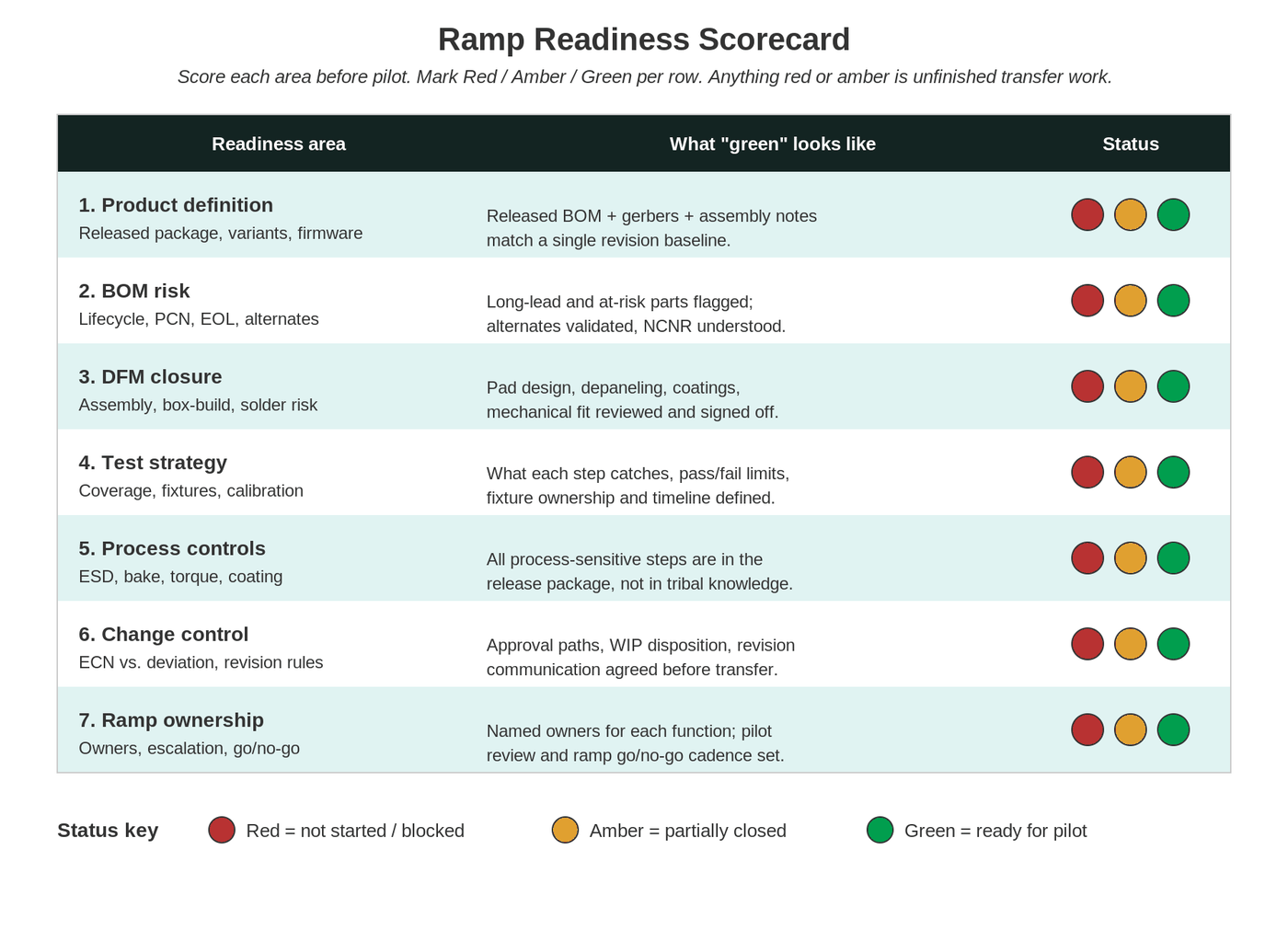
EMS Transfer Readiness Checklist for High-Mix Industrial Electronics
Use this as a fast scan against the eight readiness areas before pilot kickoff — anything in the right column means the transfer is still incomplete.
What OEM Teams Most Often Miss Before Transferring to a New EMS Partner
They confuse design completion with transfer readiness. A design can be functionally complete and still be unready for manufacturing transfer because the BOM is fragile, the DFM review is incomplete, the test method is underdefined, process controls live in tribal knowledge, change control isn’t operational, or acceptance criteria are too broad to execute consistently. That’s the difference between a product that can be built and a product that can be industrialized.
What to Do Next Before Starting the EMS Transfer
Do three things:
- Run a formal transfer-readiness review, not just an internal file handoff.
- Force unresolved issues into three buckets: must close before pilot, can close during pilot with controlled risk, and cannot be left ambiguous.
- Make the EMS partner challenge the package before materials are committed and fixtures are built.
A design-aware EMS partner adds value before the first production lot by questioning weak assumptions, surfacing build risk early, and reducing the number of expensive surprises that would otherwise appear during ramp. Once the readiness pass is complete, the next decision is which partner to award the program to — our companion piece on how OEMs should evaluate EMS partners for high-mix low-volume electronics covers that evaluation in detail.
Use this one-page inventory to bundle exactly what an EMS partner needs to quote your transfer — design data, BOM and sourcing detail, test and programming requirements, process controls, quality criteria, and program context — on a single page that travels cleanly into procurement.
Schedule an EMS Transfer Readiness Review for Your High-Mix Industrial Program
If your team is preparing to transfer a high-mix industrial electronics product to an EMS partner, talk with our engineering team before transfer risk shows up on the factory floor. We can help review build readiness, BOM risk, DFM issues, test strategy, and ramp risk before those problems turn into delays, rework, or yield loss.
FAQ: Product Transfer to an EMS Partner for High-Mix Industrial Electronics
What is the biggest mistake OEM teams make before transferring a product to a new EMS partner? Confusing design completion with manufacturing readiness. A product can be functionally complete and still be unready for transfer because BOM risk, test strategy, DFM closure, or change control aren’t finalized.
Why is product transfer harder in high-mix industrial electronics? High-mix industrial programs usually involve multiple variants, tighter traceability, tougher field environments, and more exceptions during ramp. That makes weak documentation and unresolved decisions more expensive.
What should be included in a product transfer to an EMS partner package? Released product files, controlled BOM data, variant rules, firmware and programming details, test requirements, process controls, quality criteria, traceability requirements, and clear ownership for change control and pilot escalation.
When should DFM and test strategy be reviewed during NPI handoff? Before the transfer reaches the factory floor. If DFM and test strategy are still underdefined during pilot build, the transfer is already late.
Should OEM teams use a formal transfer-readiness checklist? Yes. A formal checklist forces closure on the decisions that most often cause ramp delays, rework, test gaps, BOM instability, and pilot-build confusion.
Why EMS Transfer Readiness Decides Pilot Build Success in High-Mix Industrial Electronics
A transfer to an EMS partner for high-mix industrial electronics shouldn’t begin when the product is mostly ready. It should begin when the OEM has turned product intent into manufacturing discipline — the design aligned, BOM risk understood, DFM issues not waiting for the line to discover them, the test strategy real, process controls explicit, and finally, the ownership.

Sign up to read this article