When validated appropriately, characteristics such as class separation, output-vector position or repeatability can be useful production observables. Their role does not always need to be immediate rejection. Some may be more valuable as process indicators.
Some Measurements Should Reject Units. Others Should Monitor the Process.
A robust production-test plan usually needs more than one kind of limit.
Hard acceptance rules
These identify unambiguous nonconformities such as wrong firmware, missing model, invalid model hash, failed memory, failed sensor communication, missing calibration record or provisioning failure.
Bounded engineering measurements
These are continuous physical or signal-path characteristics such as supply current, sensor offset, calibration residual, signal amplitude, image-quality measure or timing error. Limits should come from validated engineering requirements and the measurement system—not from convenient round numbers. Where measurement uncertainty is significant, the relationship between specification limits and test acceptance limits also matters. NIST's conformity-assessment guidance explains how decision rules and guard bands affect the competing risks of accepting nonconforming product and rejecting conforming product.
Inference-specific acceptance rules
These evaluate intelligent behavior and may involve correct class plus a validated separation condition, localization error, regression error, anomaly-score region or output-vector criteria.
Statistical process indicators
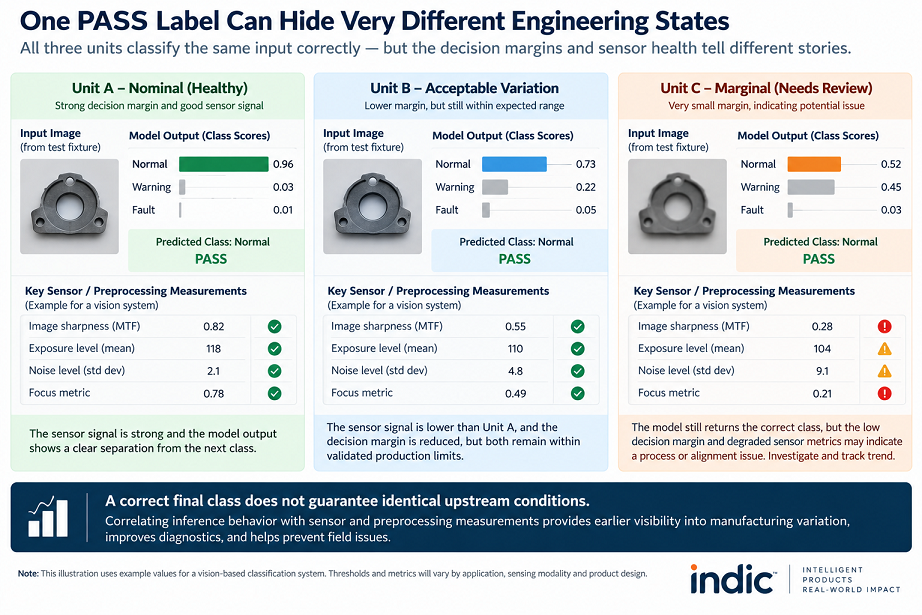
These are measurements worth recording because their movement can expose manufacturing or fixture drift before an individual unit necessarily violates the product specification. A declining classification margin across successive production lots, for example, might correlate with optical alignment movement, sensor-lot differences, fixture illumination drift, calibration change, preprocessing change or assembly-process movement.
It would be poor engineering to reject units solely because an unvalidated trend metric moved. It would also be poor engineering to discard the information. That distinction—unit acceptance versus process monitoring—is one of the most important decisions in intelligent-device production test.
Do Not Turn a Golden Unit Into the Product Specification
Golden or reference units remain useful. They can verify fixture health, detect obvious changes in test setup and provide a stable reference for line setup. But an Edge AI acceptance specification should not quietly become: every unit must behave exactly like this unit.
The reference unit has its own component tolerances, sensor behavior, alignment and calibration state. The production specification should come from the validated product definition and appropriate population evidence. The golden unit is evidence about the test system; it is not automatically the definition of a conforming product population.
Avoid Building the Fixture Around a Decision-Boundary Sample
A tempting way to make an AI production test appear rigorous is to choose a difficult sample that the model barely classifies correctly. That can produce a fragile manufacturing test.
If the stimulus intentionally lies close to the model’s decision boundary, small and otherwise acceptable changes in fixture position, sensor noise or product tolerance can dominate the result. The station then becomes extremely sensitive without necessarily becoming better at finding meaningful manufacturing defects.
For 100% production testing, use controlled stimuli with enough margin to expose the relevant hardware, sensor, calibration and execution failures without excessive sensitivity to irrelevant variation. For engineering validation and process audits, difficult examples and corner conditions can be used to characterize how product variation affects model decision boundaries. The two activities serve different purposes.
Bridging the Gap: Structuring Edge AI Test Strategy Across NPI Gates
Production-test criteria for an intelligent device are easier to defend when the evidence behind them is built progressively rather than defined only when the product reaches end-of-line testing.
EVT, DVT and PVT terminology varies somewhat among hardware organizations, but the underlying maturity progression is familiar: early builds establish whether the production-intent design works and expose failure mechanisms; later builds validate a production-worthy configuration; and production-validation builds demonstrate that the manufacturing and test processes can reproduce that configuration under production conditions.
Instrumental's overview of EVT, DVT and PVT stage gates describes this progression while also noting that individual companies may use the terms differently.
For an Edge AI product, this progression creates an important opportunity: mature the test architecture alongside the product rather than attempting to define inference acceptance criteria only when the end-of-line station is being finalized.
The allocation below is a practical engineering synthesis, not a universal EVT/DVT/PVT standard:
EVT: Establish What Can Be Observed and Isolated
At EVT, the objective is not to invent the final factory confidence threshold. It is to establish what the engineering team can observe, control and separate.
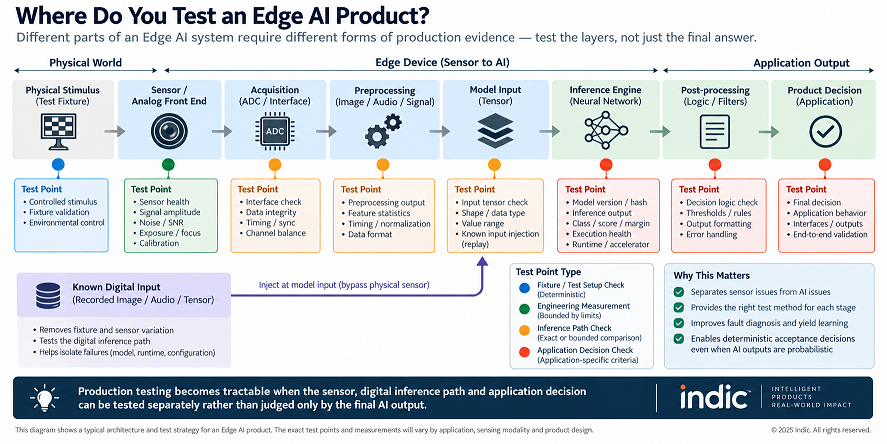
A replay input that bypasses the physical sensor, for example, is substantially easier to design while the product architecture is still flexible than after interfaces, firmware and diagnostic access have been frozen. The same is true for exposing calibration state, preprocessing statistics or other intermediate measurements that may later be needed to distinguish a sensor-path problem from an inference-path problem.
DVT: Turn Characterization Into Controlled Acceptance Evidence
By DVT, the intelligent-function stack should be treated as a controlled production-intent configuration. If model weights, quantization, preprocessing, runtime behavior or firmware change after acceptance behavior has been characterized, the affected validation evidence should be reconsidered rather than assuming that previously established limits remain valid.
DVT is also where the quality of the measurement system becomes increasingly important. A production limit is useful only if the fixture and measurement process can resolve the characteristic being controlled. Station-to-station variation, setup variation and longer-term measurement drift should therefore be distinguished from real product variation before limits are carried forward into production.
PVT: Prove the Test Process Works as a Manufacturing Process
By PVT, the question shifts from whether an engineering test can be performed to whether the manufacturing system can perform it consistently and traceably.
Can the line reproduce the intended stimulus and measurement conditions? Can a failed unit be traced to the hardware, firmware, model and calibration state under which it was tested? Can the test sequence operate within the required production cycle time without discarding evidence needed for diagnosis?
Some inference-derived measurements may also become useful process indicators at this stage. A class margin, anomaly score or other model output can be trended when validation has shown that movement in the metric correlates with a meaningful product or process condition. It should not become an individual-unit reject criterion merely because it is convenient to collect.
For an Edge AI product, the purpose of developing the test strategy through NPI is to build the evidence required for production acceptance before the production line is asked to make the final PASS/FAIL decision.
Illustrative Engineering Scenario: The Product Still Passes While the Process Moves
Consider a compact embedded vision product using a camera, fixed lens, embedded processor and classification model. At end-of-line, the fixture presents a controlled reference target. The initial acceptance criterion is simple: does the product classify the target correctly? Every unit continues to pass.
Over time, however, the mechanical position of the lens assembly begins to shift. The model is tolerant enough that the expected class remains the winner. If production records only the final class, nothing appears to have changed.
Now suppose the tester also records a validated image-sharpness measure, first-versus-second-class separation, calibration status and final class. A trend may become visible:
Mechanical change → image-quality change → input representation shifts → decision margin narrows
That sequence does not prove that a field failure will occur. It does reveal a manufacturing change that the binary model decision did not expose. The correct response is not automatically to increase the AI threshold or reject every unit. The engineering question becomes: why is the optical path moving, and is that movement still inside the validated product envelope?
This is an illustrative engineering scenario, not an Indic customer case or measured Indic production result.
Production Traceability Has to Include the Intelligent Configuration
Traditional electronics traceability commonly records hardware and firmware configuration. An intelligent product may require a broader configuration record because behavior can depend on the model file or model hash, weights, quantization, preprocessing parameters, runtime, label mapping, calibration constants, firmware and hardware revision.
Two physically identical units need not behave identically if their executable inference configuration differs. Production therefore needs enough configuration identity to reconstruct which intelligent-function stack was installed when the unit was tested.
- Unit serial or lot
- Hardware revision
- Firmware / bootloader revision
- Model identifier or hash
- Runtime or accelerator-stack revision
- Calibration revision
- Fixture or station identifier
- Stimulus/reference identifier
- Selected sensor or preprocessing metrics
- Inference result and selected inference observables
- Test-rule revision
- Final disposition
Not every raw frame or waveform needs to be stored. The objective is to retain enough evidence to distinguish later among product variation, configuration change, fixture drift and manufacturing-process movement. For conventional context, Indic’s published guide to production test and traceability describes serial-linked FCT/EOL results, firmware/checksum control and MES traceability. Those are adjacent production-test practices; this article does not claim they are evidence of a specific Edge AI customer implementation.
Design for Test Cannot Be an Afterthought
The production-test problem ultimately becomes an architecture problem. If the final product cannot expose useful sensor measurements, retrieve preprocessing diagnostics, accept an appropriate controlled digital input, identify the deployed model, identify the runtime, verify calibration state or record useful inference metrics, a production fixture cannot easily recover that observability after the design is frozen.
An Edge AI DFT review should therefore treat observability and injection as product requirements where they materially improve diagnosis. Indic’s Design for Test material similarly emphasizes adding test points, access to critical nodes and diagnostic features during design rather than after manufacturing begins.
- Can the sensor path and digital inference path be isolated?
- Can a known digital input be injected at a useful point?
- Can the relevant intermediate measurements be observed?
- Can model, runtime and calibration identity be reconstructed?
- Can a failing unit point engineering toward a likely subsystem rather than simply reporting “AI FAIL”?
Testability is not solely a fixture-design activity. Some of the most valuable production-test capabilities have to be designed into the product.
The Production Acceptance Matrix
The overall method can be summarized as an allocation problem. For every important characteristic in the sensor-to-decision chain, decide which acceptance method actually fits it.
This is not a new law of AI testing. It is a practical way to prevent every observable from being collapsed into one inappropriate confidence threshold. The production engineer’s job is not to make an intelligent device behave like a conventional resistor. It is to make the evidence supporting product conformity explicit.
The Real Goal: Deterministic Acceptance, Not Artificially Identical AI Outputs
Production quality does not require every model score to be the same. It requires a test architecture in which the reason a unit passes or fails is controlled and understandable.
Correct hardware and configuration → healthy sensor path → controlled digital execution → validated intelligent behavior → correct application decision
Some evidence in that chain is exact. Some is bounded. Some is model-specific. Some is statistical. What should not be ambiguous is the rule that turns that evidence into a manufacturing decision.
Probabilistic inference does not require probabilistic production quality. It requires a better-defined acceptance architecture.
Edge AI Production-Test Architecture Worksheet
The Edge AI Production-Test Architecture Worksheet turns the article’s reasoning into a working engineering planning tool. It helps teams map the sensor-to-decision chain, identify missing observability and injection points, assign exact, bounded, inference-specific or statistical test methods, plan known-input replay, define physical-fixture controls, specify production traceability and conduct a readiness review.
Request the Edge AI Production-Test Architecture Worksheet. Use the Indic contact form and mention “Edge AI Production-Test Architecture Worksheet” in the message field.
For additional context on Indic’s current test solutioning and automation capabilities, see Technical Expertise.
Selected Technical Sources