Supplier Quality in EMS: Audits, CAPA & PPM Turnarounds
How to tell a closed CAPA from a documented one
By Pradeep Nelamangala and Gopikrishna Mamidipudi
Abstract: Supplier quality breaks down when a corrective action is documented before it is verified. This article explains how INDIC structures supplier audits, CAPA/8D, and PPM turnaround as one evidence system: containment by serial, root-cause replication, and effectiveness verification across multiple lots — not a single re-test. It draws on two INDIC programs, a first-batch delivery with no end-of-line tester available, and an automotive battery-management-system (BMS) flash failure that took PPM from roughly 5,000 to 0, to show what separates a CAPA that is actually closed from one that only looks closed on paper.
Executive Summary
Most EMS content treats supplier quality as a scorecard: certifications held, PPM trend, on-time delivery. Those numbers matter, but they answer a different question than the one an OEM quality engineer actually needs answered during an active issue: is this corrective action durable, or did the paperwork just catch up with an unresolved cause?
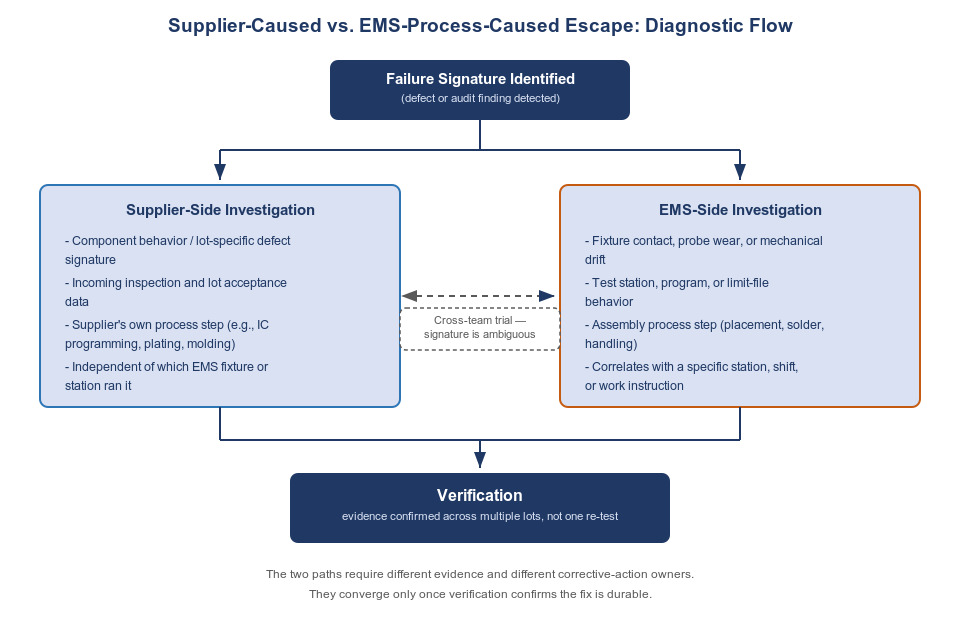
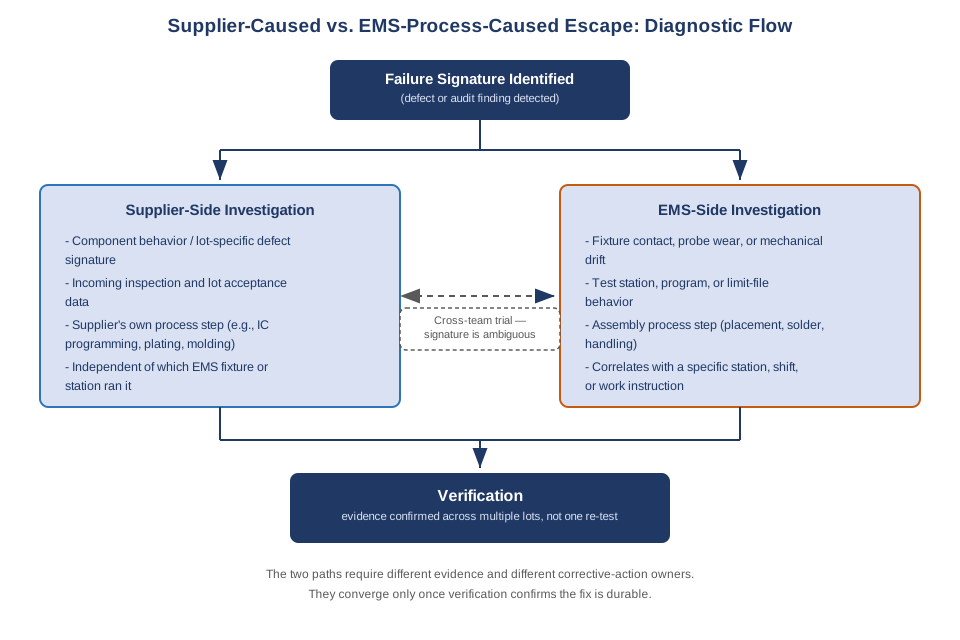
Two things are commonly missed. First, a defect's root cause can sit with the supplier (a component, a supplier process step) or inside the EMS's own process (fixture, test, assembly) — and those two situations call for different investigation paths, not the same generic "8D." Second, a PPM number is only as trustworthy as the lot/time window and defect definition behind it; a narrowed suspect range can make PPM look better without the underlying cause being fixed. This article works through both, using containment, root-cause, and verification evidence from two INDIC programs.
Why Supplier Quality and Audits Decide EMS Outcomes
An audit is really testing one thing: whether the process makes conformance the default outcome, not a result that depends on someone catching a problem manually. INDIC ties supplier quality to controls an auditor can actually inspect — layered process audits (LPA) at defined checkpoints, calibrated fixtures, versioned test limits, and MES traceability by unit serial. The point of tying it to serial-level records is specific: when an auditor asks what shipped and why, the answer should come from a log, not from someone's recollection of the build.
The PPM Turnaround Framework — and the Evidence Each Step Should Produce
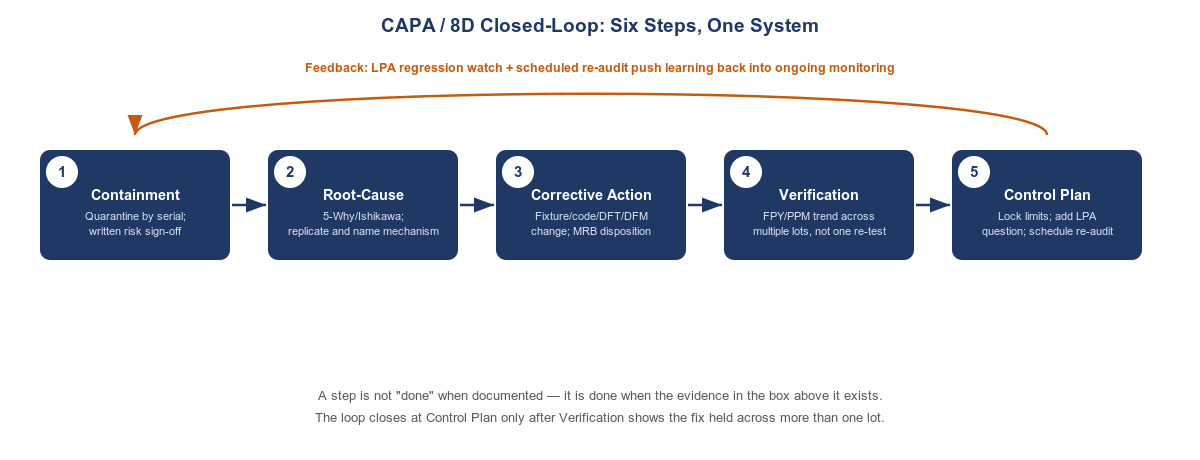
INDIC runs CAPA/8D and PPM turnaround as a six-step sequence. The sequence itself is standard practice; what is often missing in how EMS partners describe it is what evidence should exist at each step before a reviewer accepts that the step is actually done.
- Containment. Quarantine the suspect lot and serialize the affected range in MES; any temporary limit relaxation requires written risk sign-off, not a verbal exception. Evidence to expect: a by-serial quarantine record and a signed risk waiver — not just a statement that "the lot was contained."
- Problem definition. Quantify the failure signature at the relevant test stage (ICT/FCT/EOL), capture photos and logs, and confirm the measurement system (GR&R/MSA) before drawing conclusions about the cause. Evidence to expect: a defined failure signature with a confirmed measurement system, not an assumption that the test result itself is trustworthy.
- Root-cause. Run 5-Why or Ishikawa analysis across design, process, test, and supplier inputs, and replicate the failure on a golden setup. Evidence to expect: a reproduced failure under controlled conditions and a named mechanism — "component defect" or "process variation" is not a terminal root cause; the mechanism has to be specific enough to act on.
- Corrective action. Define the fixture, code, DFT, or DFM change; update work instructions and limits; train operators; disposition affected material through MRB. Evidence to expect: a documented change tied to the named root cause, not a downstream workaround that only masks the symptom.
- Verification. Re-run affected lots and confirm the improvement at station and line level by trending FPY/PPM. Evidence to expect: a trend across several subsequent lots, not a single passing re-test. A corrective action that has not been observed across more than one lot has not yet demonstrated it is durable.
- Control plan. Lock recipes and limits, add LPA questions that would catch a regression, schedule re-audits, and push the learning upstream into supplier scorecards and PPAP/APQP documentation where applicable. Evidence to expect: an updated control document and a scheduled re-audit date, not just a closed ticket.