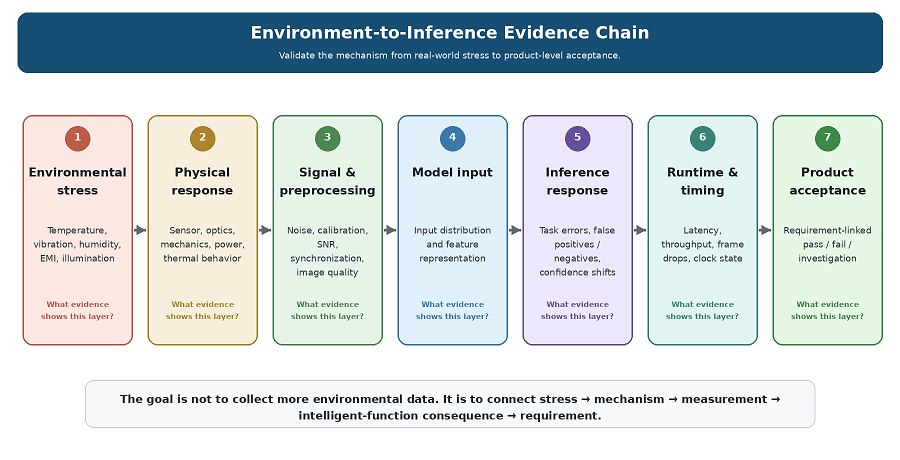
The value of this chain is that it forces the test team to ask what mechanism is being exercised and what evidence would reveal it.
This is where AI robustness guidance and physical qualification practice meet. ISO/IEC TR 24029-1:2021 provides an overview of methods for assessing neural-network robustness, while ISO/IEC 25059:2023 provides a quality model for AI systems. Those standards do not replace product-specific environmental qualification. They help establish that robustness is an AI-system quality question that must be evaluated intentionally. At the time of this revision, ISO/IEC 25059:2023 remains the published edition, and ISO lists it as expected to be replaced by ISO/IEC FDIS 25059.
How should an OEM validate inference under environmental stress?
1. Start with the mission profile and product requirement
Do not begin by selecting every available chamber or shaker test. Begin with the conditions the product is expected to experience and the decisions the intelligent function must continue to make.
MIL-STD-810’s environmental-tailoring principle is useful here even when the product is not governed by that military standard: the test profile should arise from realistic lifecycle stresses and performance requirements. Industrial, automotive, medical, defense and consumer products may each require different formal standards, but the reasoning discipline is the same.
The validation plan should identify which environmental variables plausibly influence sensing, compute, mechanics, power or communication enough to change the intelligent function.
2. Characterize single-stressor mechanisms before creating complex combined tests
Single-variable testing is often the cleanest way to discover causality. If inference quality changes as temperature rises, the team can correlate sensor telemetry, image or signal metrics, model output and compute telemetry against the same condition.
Combined-stress testing becomes valuable when the use environment or failure hypothesis justifies the interaction. Examples might include sustained inference workload at high ambient temperature, or vibration where sensor alignment is known to matter. Combining every stressor because it is available usually creates complexity without improving diagnosis.
3. Measure task performance and system telemetry at the same time
If the test records chamber temperature and a final AI accuracy number but no system telemetry, root cause can remain ambiguous. Conversely, collecting rich processor telemetry without task-level inference evidence can prove that throttling occurred without proving that the product requirement was violated.
The stronger evidence set correlates environmental condition, sensing behavior, runtime behavior and task-level outcome on the same time axis where practical.
Indic’s public test capabilities describe production-test solutioning, test automation, real-time test-data access and MES-linked traceability. Those are adjacent manufacturing and test disciplines rather than claimed Edge AI qualification experience, but they illustrate why test architecture and data capture matter when an OEM eventually needs repeatable evidence beyond an engineering bench.
4. Include representative hardware variation where it can change the conclusion
One carefully tuned engineering sample can identify a mechanism, but it may not establish population robustness. The MEMS work cited earlier is a useful reminder that thermal parameters can vary device to device and axis to axis in a studied sensor population.
The correct sample strategy is product-specific. It depends on risk, qualification requirements, supplier variation, calibration approach, available characterization data and lifecycle stage. This article should not be read as prescribing an arbitrary number of units.
5. Define acceptance against the application, not a generic AI metric
An industrial anomaly detector, a vision inspection system and a condition-monitoring node may have very different tolerances for false positives, missed events, latency and degraded modes.
The acceptance criterion should therefore answer a requirement question such as: Does defect-detection performance remain within the validated limit across the defined thermal range? Does the inference deadline remain below the maximum allowable latency during the worst sustained workload? Does sensor calibration remain within the error budget required for the model to remain valid?
Confidence score alone is usually not enough. Model confidence may be useful diagnostic evidence, but it should not automatically be treated as calibrated probability or as a universal pass/fail threshold.
Illustrative engineering scenario: an enclosed industrial vision device
Consider a representative industrial vision product that detects a defined class of manufacturing defects locally. This is an illustrative engineering scenario, not an Indic customer case.
On an open engineering bench, the system meets its detection requirement and comfortably processes the required frame rate. The camera, preprocessing pipeline, model, runtime and processor configuration are frozen for validation.
The product is then installed in its intended enclosure and exercised under an elevated ambient condition while the normal sustained inference workload is running.
The electronics remain operational. There is no reboot and no obvious communication failure. If the validation stopped at functional survival, the product could appear to pass.
But the more complete test records several layers simultaneously. Camera-module temperature and image-quality indicators move with the environment. The processor approaches a thermal-control region. Inference latency trends upward. The validation dataset includes samples close to the product’s actual decision boundary, so the team can also observe whether the error distribution changes under the same conditions.
There are several possible outcomes, and the test should not presuppose which one will occur. The camera shift may prove negligible after preprocessing. Thermal design may keep compute performance stable. Or one of those mechanisms may reduce margin enough to violate the product requirement.
The value of the test is not that it guarantees a failure. The value is that it replaces an assumption with evidence.
What an environmental-inference failure can change in the product design
When the failure mechanism is understood, the corrective action may sit far from the model itself.
A sensor-domain problem can lead to a different sensor selection, revised calibration strategy, optical shielding, compensation algorithm or tighter control of mounting and alignment. A compute-timing problem can lead to changes in heat spreading, airflow, enclosure conduction path, power-mode selection, workload allocation or processor choice. A signal-integrity or EMI-sensitive problem may require layout, shielding, filtering or grounding changes.
That is why environmental AI validation belongs inside product engineering rather than being treated as a late software check. Indic’s Product Engineering and Testing & Quality capabilities are relevant adjacent disciplines: the important industrialization question is how validation evidence feeds back into the physical design and then into repeatable test.
Where the discovered variable also needs production control, Design for Test becomes part of the discussion. The production test may not reproduce a full environmental qualification cycle, but DFT can determine whether the product exposes the telemetry, calibration access, test points, built-in diagnostics or configuration traceability needed to prevent an environmentally sensitive design from becoming an uncontrolled production population.
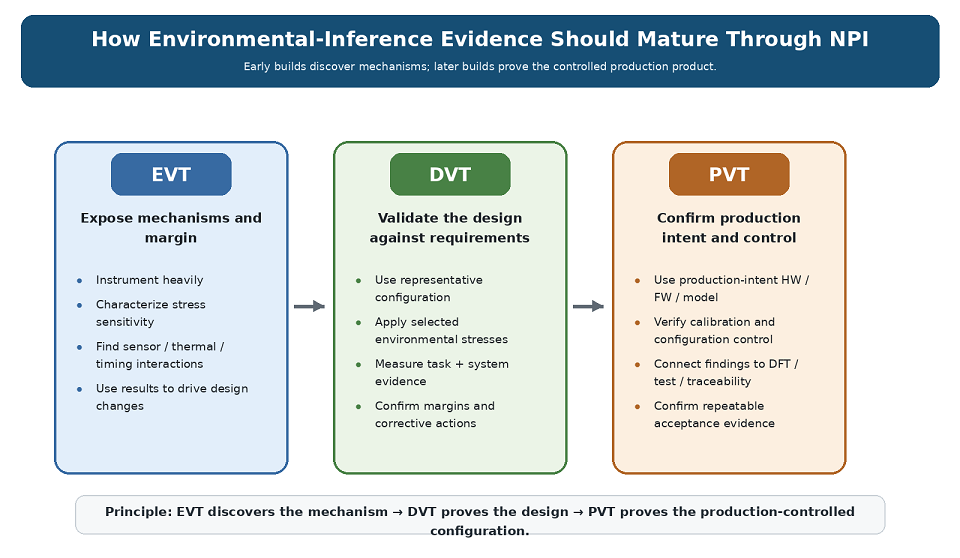
How the evidence should mature through EVT, DVT and PVT
Environmental inference validation should mature with the product rather than appear as a one-time qualification event immediately before release.