What OEMs Should Measure Instead of Relying on TOPS for Edge AI Processor Selection
The problem with TOPS is not that the number is useless. The problem is asking it to prove more than it can. A processor specification can help an engineering team decide what deserves evaluation. It cannot, by itself, demonstrate that the complete product will meet a timing, throughput, task-quality, energy, or sustained-operation requirement.
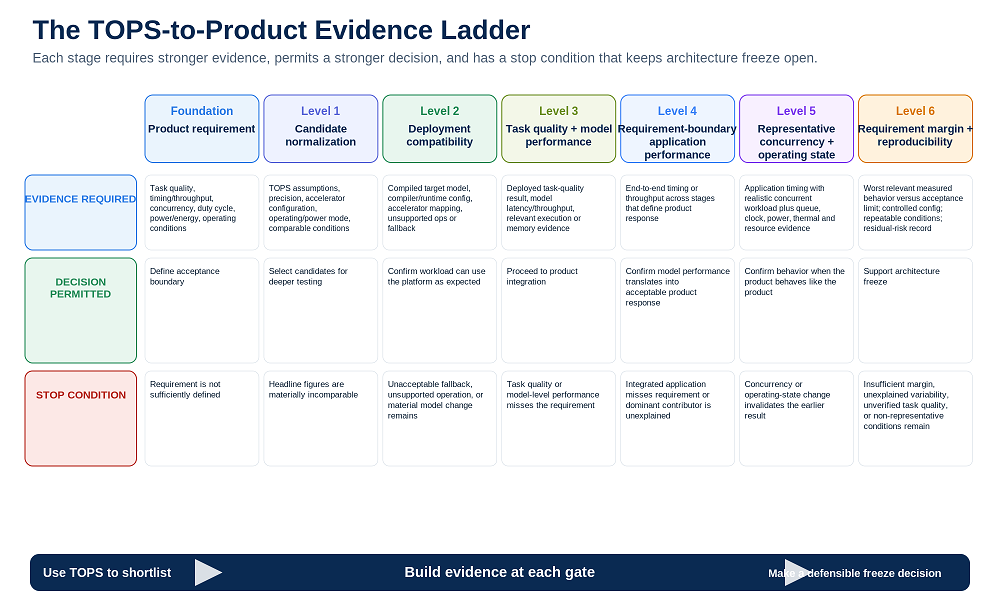
That distinction becomes more important as the cost of changing the architecture increases. Early in selection, proxy specifications are efficient. Near architecture freeze, the evidence has to move closer to the product itself.
Use TOPS to shortlist candidates, not to freeze the architecture
TOPS—trillions of operations per second—describes arithmetic capability under a particular implementation and set of assumptions. Qualcomm's explanation of AI TOPS describes it as potential peak inference performance and explicitly notes that memory bandwidth, software optimization, and system integration affect real application performance.
That makes TOPS useful for coarse screening. A platform that is clearly in the wrong compute class can be removed before the team spends time on model conversion, profiling, software integration, thermal design, or application benchmarking. But the specification becomes weaker evidence as the engineering question changes from 'Is this worth evaluating?' to 'Can we commit the product architecture to this platform?'
Published TOPS figures also need context. Precision, accelerator configuration, operating mode, and the convention used for counting operations can differ. The right response is not to discard TOPS; it is to limit the decision authority granted to it.
Define the product acceptance boundary before benchmarking
Processor evaluation should begin with the product requirement, not the processor datasheet. The same Edge AI workload can create different acceptance conditions depending on what the product must do.
A vision system may be constrained by the time from an available frame to an actionable result. A multi-camera product may be constrained by the number of streams that can run without queue growth or missed deadlines. A battery-powered sensor may tolerate more latency but have a much tighter energy budget. A safety- or quality-sensitive application may have a task-quality threshold that cannot be traded away for speed.
| Product question | Evidence that may define acceptance |
|---|---|
| Does the intelligent function remain correct enough? | Application-specific task-quality metric and acceptance limit |
| Does the product respond in time? | Requirement-boundary latency and the statistic appropriate to the deadline |
| Can the product sustain the required work rate? | Throughput, queue behavior, missed work, or dropped frames |
| Can required streams or tasks coexist? | Concurrent workload behavior and shared-resource evidence |
| Does the compute fit the power or energy envelope? | Power, energy per task or duty-cycle evidence under the intended mode |
| Does performance hold in the intended operating state? | Application timing correlated with relevant clock, power, and thermal observations |
These are examples, not a universal checklist. The acceptance boundary is product-specific. If the requirement is not defined, a benchmark cannot become architecture-acceptance evidence because there is nothing defensible to compare it against.
A performance number has a measurement boundary
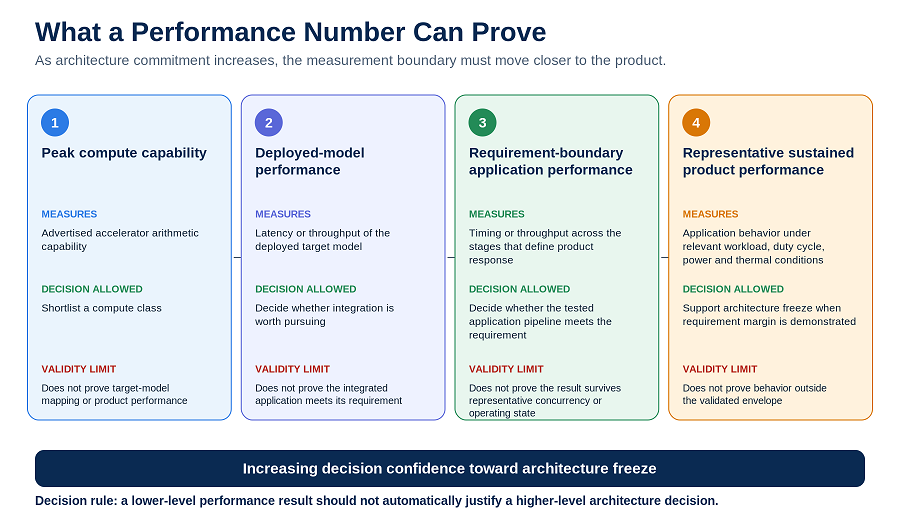
Several different measurements are commonly described as 'AI performance.' They are not interchangeable because each includes a different amount of the real product.
| Evidence boundary | What is measured | Decision it can support | What it does not prove |
|---|---|---|---|
| Peak compute capability | Advertised accelerator arithmetic capability | Which compute class or platform deserves evaluation | That the target model maps efficiently or meets a product requirement |
| Deployed-model performance | Latency or throughput of the target model on the candidate platform | Whether the workload executes effectively enough to justify integration | That preprocessing, postprocessing, I/O, and other product work meet the requirement |
| Requirement-boundary application performance | Timing or throughput across the application stages that materially define product response | Whether the integrated pipeline meets the requirement in the tested condition | That the result survives representative concurrency, power, or thermal state |
| Representative sustained product performance | Application behavior under relevant concurrent workload, duty cycle, power, and thermal conditions | Whether the architecture has product-specific evidence for freeze | Behavior outside the validated workload and operating envelope |