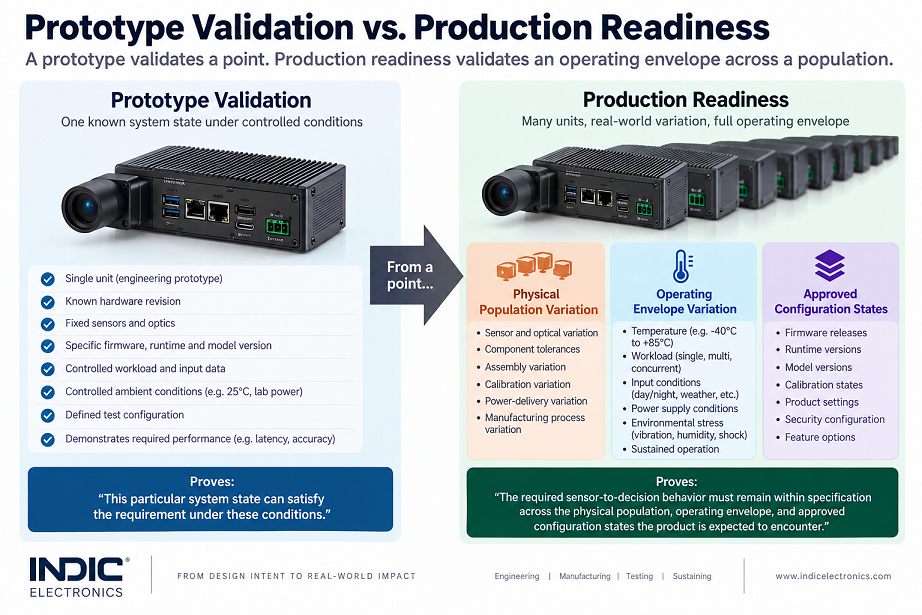
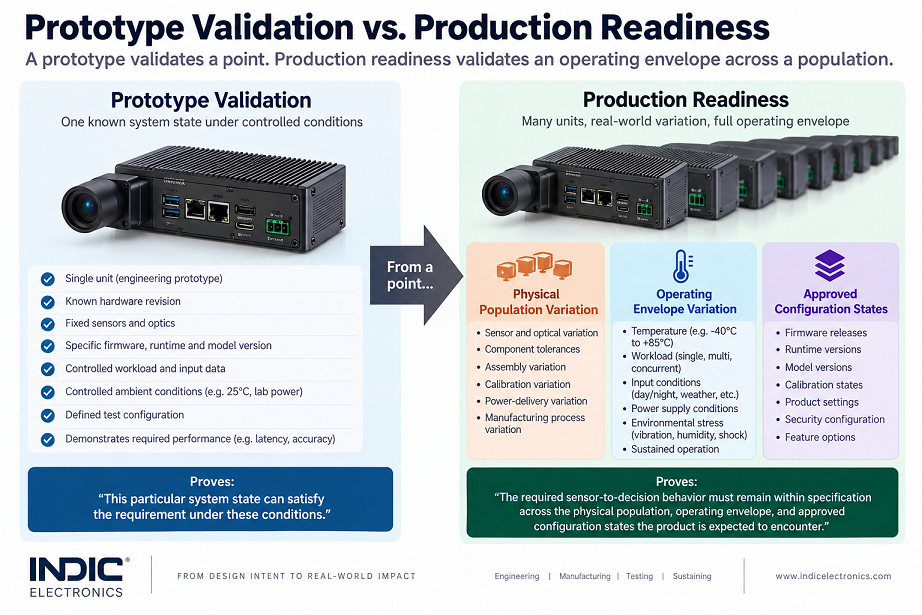
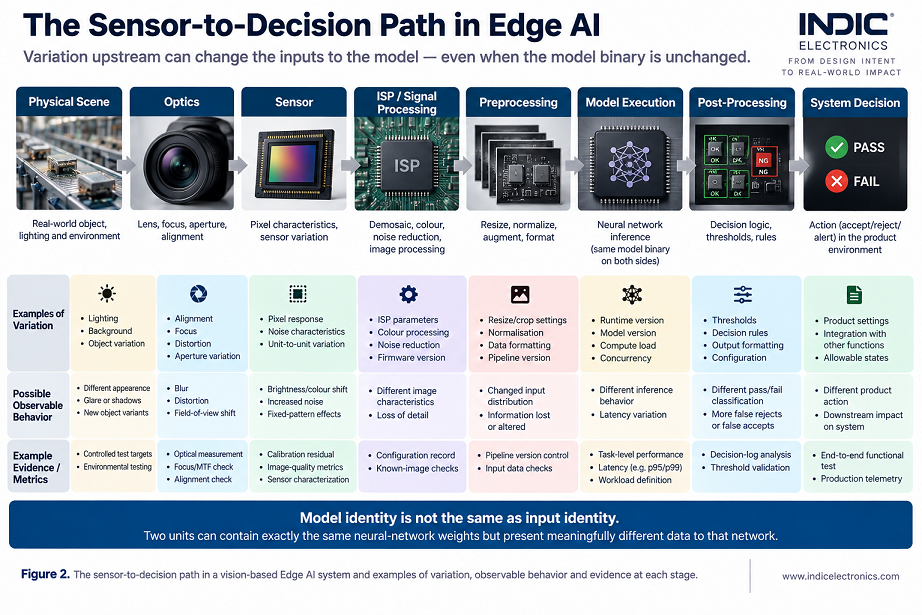
Variation introduced upstream can alter the information presented to the model even when the neural-network weights themselves are unchanged.
Depending on the product, relevant factors may include:
- optical alignment;
- focal characteristics;
- distortion;
- sensor response;
- calibration;
- ISP configuration;
- mechanical displacement;
- preprocessing.
The important distinction is:
Model identity is not the same as input identity.
Two units can contain the same model binary while presenting different representations of the physical world to that model.
Camera-aware neural-network research provides a useful example of this principle. The CAM-Convs work at CVPR 2019 showed, for the single-view depth-estimation task studied, that a network trained using images from one camera model generalized poorly to imagery from a different camera model, and that explicitly accounting for camera parameters improved cross-camera generalization.
That evidence should not be stretched into the claim:
Camera manufacturing variation causes Edge AI failure.
That would be too broad.
The defensible conclusion is narrower:
Where task behavior is sensitive to the sensor, optical or calibration characteristics that determine model input, those characteristics belong inside the product-validation argument.
The causal path becomes:
sensor / optical / calibration change -> changed input representation -> possible change in task behavior -> product requirement evaluated
Useful evidence depends on the product and failure mechanism. It might include:
- calibration residual;
- known-target response;
- image-quality measurement;
- controlled task-level test;
- another product-specific discriminating metric.
There is no universal test.
The measurement should be selected because it exposes the mechanism that can move the product requirement.
Engineering Check for PVT
If apparently equivalent units communicate correctly and inference executes, but task behavior varies between units, ask whether manufacturing control proves only sensor availability or also the optical/calibration characteristics that materially affect the AI input.
Compute Performance Is a System Behavior, Not an Accelerator Specification
A second scale-up assumption is:
The accelerator met the target in development, so the production system has adequate inference performance.
That may be true.
But it has not been proven merely by establishing accelerator capability.
End-to-end product timing can also depend on:
- preprocessing;
- memory traffic;
- CPU activity;
- accelerator utilization;
- scheduling;
- I/O;
- concurrent workloads;
- post-processing;
- power state;
- thermal state.
For many real-time products, average latency is not enough.
A system may meet its average latency requirement while occasionally missing a deadline because of tail behavior.
MLPerf's use of defined scenarios and metrics illustrates why workload context matters. A benchmark result is associated with a system and software stack and is generated under defined load rules rather than treated as a universal property of the accelerator.
The production lesson is not:
Use MLPerf as your PVT test.
It is:
A meaningful performance claim needs a defined complete system, workload, operating condition, duration and metric.
Before release, useful questions therefore include:
- What exact workload produced the passing result?
- What other processing was active?
- Was this a short burst or sustained operation?
- Is average latency the real product metric?
- Does tail latency or deadline-miss rate matter?
- Which firmware and runtime configuration was used?
- Which power state was active?
- At what thermal condition was the measurement taken?
That shifts the engineering question from:
Did the accelerator benchmark pass?
to:
Did the complete product maintain the required behavior across the workload conditions that matter to the application?
Thermal and Power Conditions Can Produce a Performance Failure Without a Functional Crash
An Edge AI product does not have to stop working to fail its requirement.
It can remain operational while becoming too slow.
Modern compute platforms use thermal and power-control mechanisms to keep silicon and system operation inside electrical and thermal limits.
NVIDIA's Jetson Thor power and thermal-management documentation provides a concrete example. It describes thermal zones, trip points and a feedback governor in which increasing temperature can select progressively stronger cooling states. Those states reduce allowable CPU and GPU clock frequencies. NVIDIA explicitly notes that software clock throttling directly affects performance.
For that platform, a defensible causal chain is:
temperature rises -> thermal-control feedback selects stronger cooling state -> CPU/GPU frequency caps decrease -> available execution performance decreases -> inference latency or throughput may move outside the product requirement
The finished product can encounter a different thermal condition from the development setup because it may have:
- a sealed or constrained enclosure;
- neighboring heat sources;
- different airflow;
- final thermal-interface materials;
- sustained AI workloads;
- simultaneous subsystem activity;
- different ambient conditions.
The AI model has not changed.
The environment in which it executes has.
Power delivery can produce another path.
NVIDIA also documents hardware clock throttling in response to current/power limits and fast transient conditions such as overcurrent or voltage drop at the PMIC.
For that implementation:
power-delivery transient -> current or voltage-limit event -> hardware clock throttling -> reduced available compute performance -> product timing requirement may be at risk
This is a platform-specific example, not a claim that every Edge AI processor behaves identically.
The broader product-development lesson is:
When a platform can dynamically alter available compute performance in response to thermal or electrical state, sustained system validation must observe those states rather than treating compute capability as fixed.
Useful evidence may include:
- temperature;
- clock state;
- current or power behavior;
- workload state;
- sustained latency;
- throughput;
- throttling indicators.
No universal temperature or latency threshold should be invented.
Those limits belong to the product requirement and architecture.
Engineering Check for Sustained Performance
If tail latency grows under sustained operation, correlate timing with temperature + clock state + workload + power behavior before assuming the regression is necessarily in the model or runtime.
For broader environmental validation, Indic already describes environmental stress and screening work involving temperature variation, humidity, vibration and shock. That is relevant adjacent engineering capability; it should not be represented as evidence of prior Edge AI deployments.
Intelligent-Device Identity Can Extend Beyond the BOM
Traditional manufacturing genealogy asks:
What physical product did we build?
Depending on risk and process, that may involve:
- serial number;
- component or lot information;
- assembly history;
- process history;
- test results.
IPC-1782B establishes minimum manufacturing and supply-chain traceability requirements based on perceived risk for electronic products, processes, assemblies, parts and components.
But IPC-1782B does not prescribe:
- AI model hashes;
- Edge AI MLOps;
- runtime genealogy;
- model-release management.
Those should not be attributed to the standard.
Intelligent hardware adds a separate systems-engineering question:
What information must be reconstructable later to determine the behavioral state of an affected unit or production population?
Depending on architecture, that may involve:
- firmware;
- BSP or operating-system build;
- inference runtime;
- model version;
- preprocessing configuration;
- calibration;
- product settings.
The correct granularity is architecture-dependent.
For example:
- calibration may be unique to a unit;
- firmware may correspond to a production release;
- runtime may be controlled at product-build level;
- model version may be fleet-controlled;
- configuration may vary by product variant.
That does not imply every item must always be stored independently against every serial number.
The useful principle is:
If a hardware or configuration state can materially influence product behavior or root-cause analysis, the organization should know how that state is controlled and how it can be reconstructed for the relevant unit or population.
This is where manufacturing genealogy and intelligent-device configuration management begin to overlap.
Indic already documents adjacent production test and traceability practices in which firmware version/checksum is associated with unit serial in MES and ICT/FCT/EOL results write to the same record.
That does not establish direct Edge AI production experience.
It does demonstrate an underlying production-control discipline relevant to more complex intelligent-device genealogy.
A Functional Pass Is Not Automatically Proof of Intelligent-Function Conformance
Terms such as ICT, FCT and EOL describe categories of production test.
They do not, by themselves, define the failure mechanisms each station covers.
Indic's published DFT and ICT/JTAG/FCT/EOL coverage planning already makes this distinction in conventional electronics by allocating coverage across ICT, boundary-scan JTAG, FCT and EOL through a coverage matrix.
A production station might establish that:
- power rails are present;
- interconnects are correct;
- interfaces communicate;
- the sensor responds;
- firmware loads;
- inference executes;
- an output is generated.
But another question may remain:
Does the complete intelligent function meet the product requirement under the conditions allocated to this verification stage?
Possible gaps could involve:
- calibration sensitivity;
- controlled input-path variation;
- sustained thermal behavior;
- workload-dependent tail latency;
- configuration mismatch.
It would be equally wrong to conclude:
FCT cannot test these things.
A properly engineered FCT or EOL station can include:
- controlled stimuli;
- calibration procedures;
- realistic sensor stimulation;
- latency measurements;
- task-level checks;
- thermal-state checks;
- product-specific extended workloads.
The issue is therefore not the station's label.
It is coverage.
Assembly Integrity
Was the hardware assembled correctly?
Functional Conformance
Do the required hardware and software functions operate?
Intelligent-Function Conformance
Does the complete sensor-to-decision system satisfy the product behavior allocated to this verification stage?
And importantly:
Not every product requirement needs to be retested on every production unit.
Some relationships should be established in DVT or qualification.
Some should be demonstrated for manufacturing reproducibility during PVT.
Only the appropriate controls need to become unit-level production tests.
Production Readiness Is an Evidence-Allocation Problem
Listing scale-up risks is not enough.
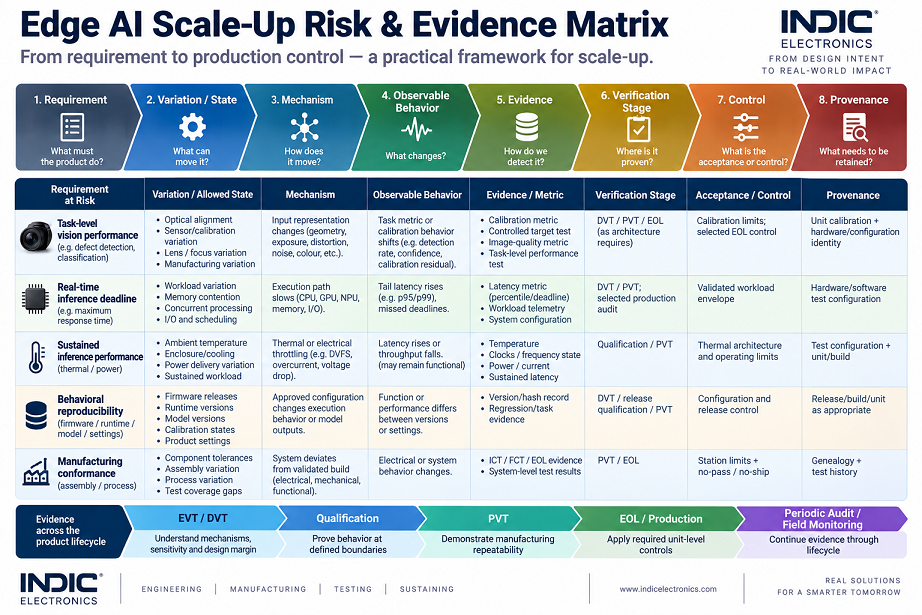
The useful question is what the engineering team does with them.
For every significant product requirement, the team should be able to answer:
- What variation or allowed state can move the requirement?
- Through what mechanism?
- What observable behavior changes?
- What evidence discriminates the change?
- At which lifecycle stage should that evidence be generated?
- What acceptance criterion or control follows?
- What provenance will be required later?
A practical engineering synthesis is the Edge AI Scale-Up Risk & Evidence Matrix: