How OEMs Should Evaluate EMS Partners for High-Mix Low-Volume Electronics Manufacturing
By: Shirin Khanna : Chief Strategy Officer, LinkedIn: https://www.linkedin.com/in/shirinkhanna/ Reviewed by: VAISHNAVI CHANDRAN : Manufacturing Engineering Lead, LinkedIn: https://www.linkedin.com/in/vaishnavi-chandran/
High-volume manufacturing optimizes around scale: stable demand, frozen designs, line efficiency, and tooling that pays for itself across millions of units. HMLV programs run on the opposite reality — more variants, more changeovers, smaller lots, continuous engineering involvement, and designs that are often still moving. Treating an HMLV program like a small version of a high-volume one is the most common and most expensive evaluation mistake an OEM can make.
The difference matters most for industrial electronics, where products carry long field lifecycles, harsh operating conditions, and low tolerance for failures. A cheap build that passes visual inspection is not enough. The partner has to understand how engineering decisions, sourcing decisions, and factory execution connect — because in HMLV work the complexity lives in setup, documentation, change control, test definition, and first-article validation, not in placing the component.
This is also where the Tier-1, high-volume EMS model can quietly misfit. Large Tier-1 manufacturers are excellent for mature products with predictable forecasts and enough volume to justify dedicated automation. But a supplier built for high-volume efficiency can struggle when every build has different variants, open engineering questions, and frequent documentation updates. The issue is fit, not capability ranking: does the partner’s operating model match your product’s complexity, volume pattern, and engineering maturity?
A real example shows what poor fit costs. A Swedish company building a solar-powered water-distribution system for smallholder farmers first placed manufacturing with a Taiwanese partner whose model couldn’t scale to the work. The product was sophisticated and high-mix, demand was uneven, and the supplier could build boards but couldn’t absorb the engineering changes, sourcing variation, and process refinements the program kept generating. When Indic took over, the problem wasn’t a single defect to fix — it was the absence of control around variation. Rebuilding the transfer discipline (BOM reviewed against sourcing risk with documented alternates, DFM and DFT checks built into the flow, changes routed through controlled documentation, a test strategy matched to the product) moved the program from reactive build execution to controlled repeat production. Within a few months production cost fell about 45%, output rose roughly 25%, and the defect rate dropped about 15% — and the customer used the Indian operations as the platform to enter other Asian and African markets.
A capable HMLV partner brings structure to ambiguity without burying the OEM in bureaucracy. Concretely, it should be able to:
- Review the design package before quoting too aggressively
- Identify DFM and DFT risks before pilot build
- Challenge unclear assembly notes, test assumptions, and revision status
- Review the BOM for lifecycle, availability, and alternate risk
- Build a practical test and inspection plan
- Handle engineering changes without confusing revisions on the shop floor
- Provide traceability matched to the product’s risk profile
- Communicate issues early — not after the delivery date is already at risk
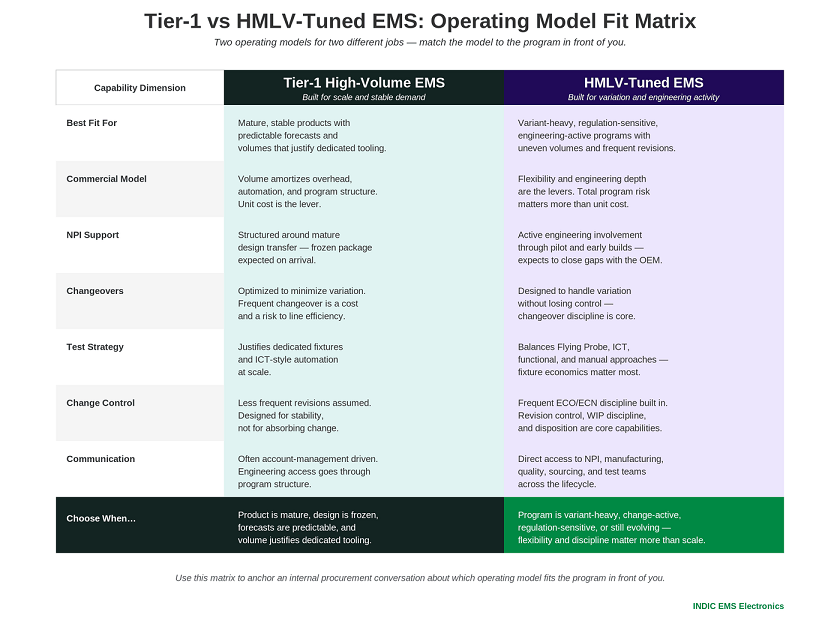
There are essentially two operating models in front of you when you evaluate an EMS partner for a high-mix low-volume program. One is the Tier-1 high-volume model — purpose-built for stable, mature products with predictable forecasts, where scale, automation, and program overhead pay back across millions of units. The other is the HMLV-tuned model — purpose-built for variant-heavy, regulation-sensitive, engineering-active programs, where flexibility, continuous engineering involvement, and disciplined change handling matter more than line efficiency. Neither model is universally better; they are built for different jobs. The rest of this article is a sustained comparison across the dimensions that actually decide which model fits the program in front of you.
The two tables below summarize where HMLV evaluation diverges from the high-volume default.
The 5-Minute EMS Partner Evaluation Scorecard
If you get only one short evaluation call, these five questions reveal more than any capability deck. You’renot listening for “yes, we have experience.” You’re listening for operating discipline.
Evaluating NPI and Design-Transfer Discipline: Where Operating Models Diverge
NPI is where an EMS relationship either starts strong or begins to fail quietly. In HMLV electronics the transfer package is almost always imperfect: drawings incomplete, test specs immature, the AVL carrying risk, mechanical constraints not fully understood, firmware and calibration requirements still evolving. A strong partner doesn’t simply accept the package and start procurement — it reviews the transfer like a manufacturing system and surfaces the gaps before they reach the floor.
Be wary of any partner that races from RFQ to production without structured questions. Speed is only valuable when the process underneath it is in control.
NPI Bridge Between Engineering and Production: What HMLV EMS Partners Need
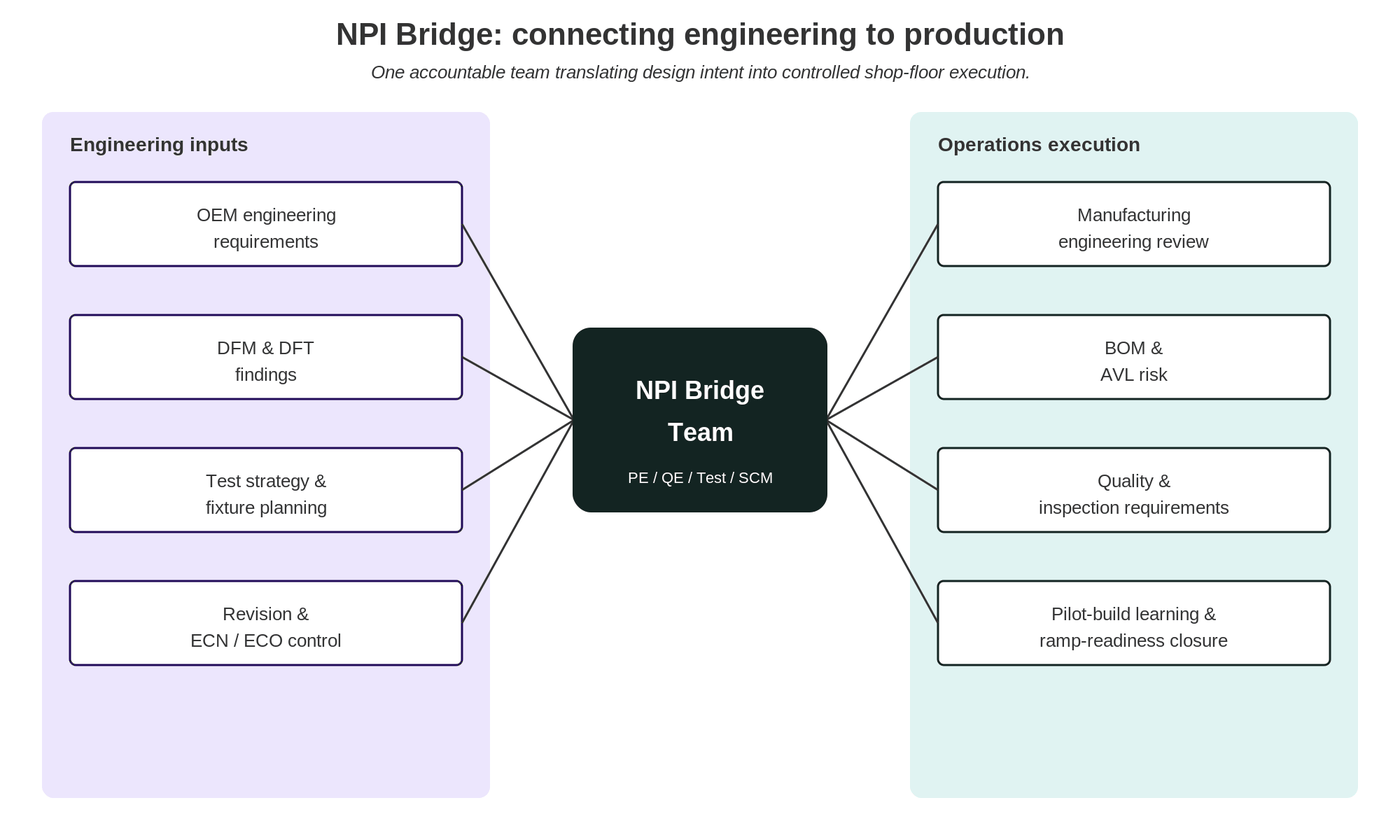
HMLV programs need an NPI bridge team — people who translate design intent into controlled shop-floor execution before the product is thrown into production. It matters because transfer problems rarely sit in one function. A BOM issue ripples into sourcing, test, scheduling, and customer approval. A layout issue touches solderability, inspection, rework, and fixture access. A firmware-loading requirement reshapes test flow, serialization, and traceability.
Ask who owns this bridge inside the organization. If the answer is unclear, the program will be handed from sales to sourcing to production with no single team controlling transfer risk. A strong bridge connects OEM engineering requirements, manufacturing engineering review, DFM/DFT findings, BOM and AVL risk, test strategy and fixture planning, quality and inspection requirements, revision and ECN/ECO control, and pilot-build learning through to ramp-readiness closure.
What this looks like in practice: on an industrial PCBA program with a dense board layout, inadequate test points would have shipped a fault-coverage gap straight through to high final-test failure rates after launch. The pre-pilot DFT review caught it. Working with the OEM’s engineering team, Indic recommended adding test points to the layout — a small change at design that turned thin fault isolation into component-level coverage, dropped final-test failures, lifted first-pass yield, and substantially reduced the field-failure probability that incomplete test coverage would otherwise have carried. The OEM didn’t miss a design flaw; what was missing was the buildability-and-testability eye that an NPI bridge applies before pilot. The Tier-1 high-volume model expects a frozen, fully-DFM-closed package on arrival; the HMLV-tuned model expects to find the gaps and close them with the customer’s engineering team.
DFM, DFT, and Engineering Support: How HMLV-Tuned EMS Partners Show Up Differently
For HMLV programs, DFM and DFT aren’t optional extras; they’re part of manufacturing readiness. DFM determines whether the product can be built repeatably, DFT whether it can be tested effectively — and both drive cost, yield, debug time, and delivery reliability. A weak partner says, “We’ll build to your design.” That sounds cooperative but it’s a warning: a stronger partner says, “We can build this, but these areas need review before we commit to repeatability.” The partner doesn’t need to redesign your product — it needs to spot the design decisions that will hurt manufacturing performance.
Supply-Chain Strength in EMS Evaluation: Buying Parts vs Managing Risk
For HMLV electronics, supply-chain strength isn’t the ability to buy parts — it’s the ability to manage component risk without creating engineering or quality risk. This matters most for industrial products that stay in the field for years, where a substitution made casually during a shortage can create fit, performance, compliance, reliability, firmware, or calibration problems. A capable partner reviews the BOM with both sourcing and engineering judgment.
The real danger isn’t only that a part goes unavailable. It’s that someone solves the availability problem in a way that creates a product problem. At meaningful scale, controlled alternate sourcing is part of the turnkey offering, not an exception. Indic pairs procurement with engineering review before any substitution is committed: lifecycle and PCN exposure are tracked continuously, alternates are validated against the original part’s fit, electrical performance, thermal margin, and supplier credibility, and customer approval is gated against documented evidence before a substitution reaches the line. That discipline is backed by depth — more than 200 supplier relationships balanced across ASEAN, EU, and North America, with digital sourcing through CalcuQuote. Through the COVID-19 component crisis, when many manufacturers absorbed line stoppages or last-minute uncontrolled substitutions, Indic did not face a single shortage that stopped production. The point of supply-chain capability is not to claim substitutions never happen; it’s to make sure each one is engineered, documented, and approved before it touches a build.
Test Strategy, Quality Controls, and Traceability: An Operating-Model Comparison
Testing is one of the most common failure points in HMLV programs, usually because of a gap in assumptions: the OEM expects the partner to “handle testing,” the partner expects the OEM to have defined the requirements, and neither happens. A capable partner clarifies test expectations early — what must be electrically tested, functionally verified, programmed, or calibrated; which failures must be logged; what data must be traceable; what the retest rule and acceptance standard are.
For complex assemblies, ask whether the partner uses a structured test-coverage framework such as PCOLA-SOQ or an equivalent internal method. The acronym isn’t the point; the point is whether they can articulate what the strategy actually catches — presence, correctness, orientation, live behavior, alignment, shorts, opens, and quality defects. A serious in-house test stack spans in-circuit test, fixture-less Flying Probe for low-volume and NPI builds, functional test (commonly automated in LabVIEW or Python), on-board programming, end-of-line and hi-pot testing, and reliability screening — with results bound to each unit’s serial number through the MES so build history is retrievable on demand.
Then ask how the partner tracks first-pass yield during pilot build and the first three production lots. In early HMLV builds FPY is not just a quality metric — it’s a learning signal that shows whether defects are being understood, corrected, and prevented from recurring. The strongest partners close that loop with data: analytics layered onto inspection (for example, a WATS-style system over AOI) can cut defect escapes by up to 20% by turning detection into a detect-analyze-correct-verify cycle rather than a pass/fail gate.
Test-Fixture Economics: Where the Operating Models Pay Off Differently
In high-volume manufacturing, dedicated fixtures and automation are easy to justify because their cost spreads across many units. In HMLV the economics invert, and the partner has to help you choose a test approach that balances coverage, cost, debug speed, repeatability, and build volume. A supplier that pushes the same test model at every program isn’t thinking carefully enough: some products justify ICT, others are better served by Flying Probe during early builds, followed by functional test and selective fixture investment once the design stabilizes.
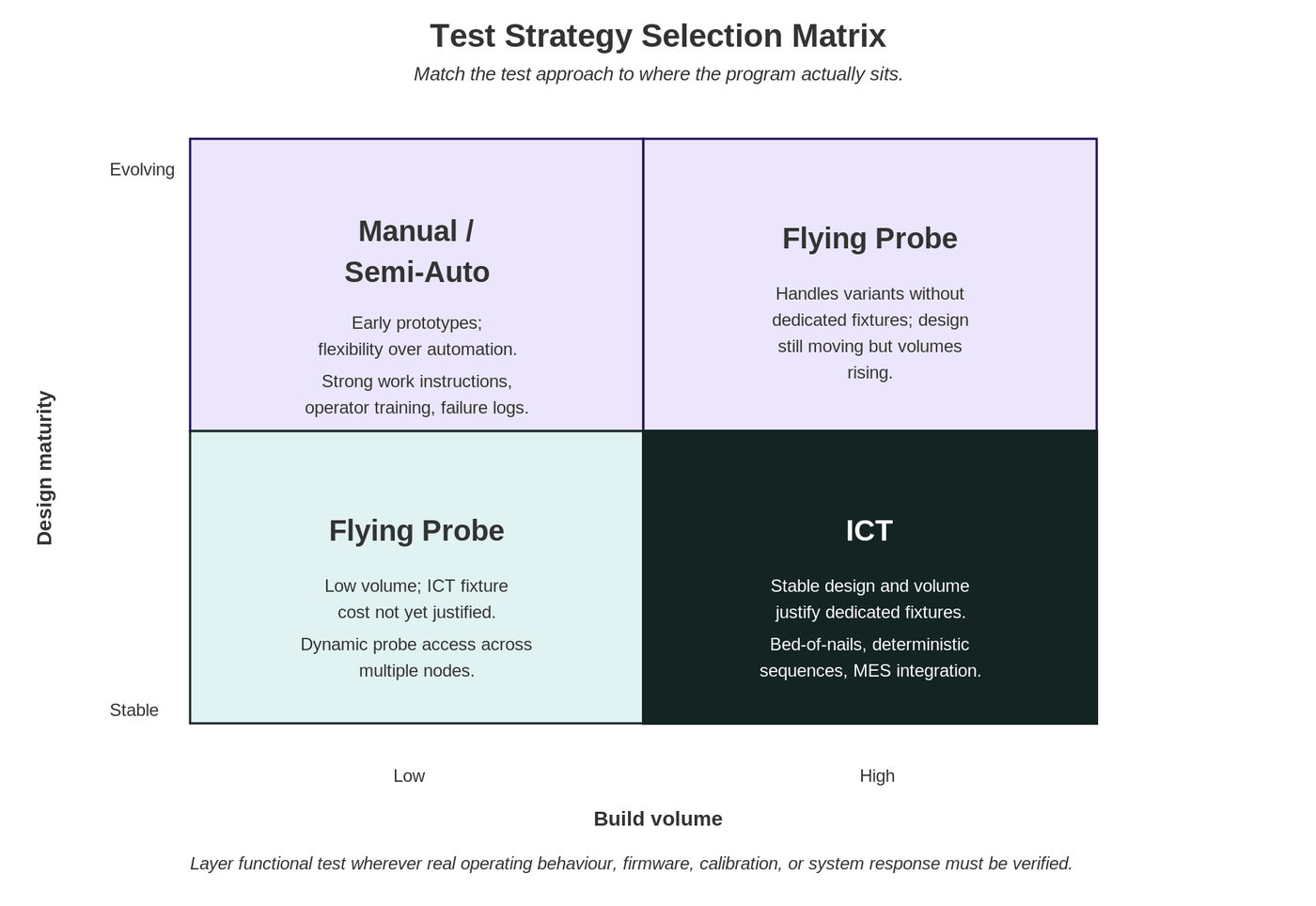
Note on the matrix: Flying Probe appears in two quadrants because it is the right test approach whenever ICT isn’t yet justified — either because the design is still evolving (top-right) or because volume hasn’t crossed the threshold where a dedicated bed-of-nails pays back (bottom-left). In both cases, Flying Probe’s fixture-less, dynamic-probe access is the practical choice until ICT becomes economically defensible.
The right question isn’t “Do you have test capability?” It’s “How will you choose the right test strategy for this product, this volume, this maturity, and this risk profile?” On an EV charger program for an Indian automaker, the original test architecture ran programming and functional verification on the same station — it worked, but it stacked two different jobs onto one expensive piece of equipment, and as volumes scaled the line slowed and cost per unit climbed. The fix was to make the strategy more specific, not larger: programming moved to lower-cost stations dedicated to firmware loading, and the functional station was rebuilt around what only it could verify — real operating conditions, fault response, and the limits the customer cared about in the field. Throughput rose roughly 60% and direct test cost fell about 20%, with no new capital equipment, because the team defined what each test step was there to catch.
Quality Controls Across Variant-Heavy Production
Quality in HMLV manufacturing isn’t only certifications and inspection steps — those matter, but they don’t tell the whole story. The real question is how the partner controls variation, because with frequent changes and small lots the factory can’t lean on repetitive scale to stabilize the process. Look for disciplined documentation, per-variant work instructions, inspection checkpoints, first-article controls, and feedback loops from defects. Foundational systems and standards signal seriousness here: an ANSI/ESD S20.20-compliant facility, IATF 16949 for automotive programs, and build to IPC-A-610 Class 2 with Class 3 capability for high-reliability work.
- Clear work instructions for each variant
- First-article inspection discipline
- Controlled rework process
- Non-conformance tracking and CAPA
- Revision-controlled documentation
- Operator training and build notes
- Incoming inspection for critical parts; in-process inspection where needed
- Final inspection tied to customer acceptance requirements
- FPY tracking during pilot build and early production lots
The right partner can explain how quality is built into the process, not just inspected at the end.
Change Control Under Frequent Revisions: How Operating Models Hold (or Break)
Engineering changes are normal in HMLV programs. The problem is never that changes happen — it’s that they get handled casually. A weak ECO process produces wrong-revision builds, mixed inventory, unclear rework instructions, obsolete parts in use, test mismatches, and customer confusion, any of which can become serious field risk in industrial electronics. Ask how the partner controls changes from receipt to implementation:
- How are ECOs and ECNs received, reviewed, and acknowledged?
- Who checks impact on BOM, drawings, firmware, test, labels, and packaging?
- How is old inventory handled, and how are open WIP and finished goods controlled?
- How are operators notified, and how is the effective date or serial-number range documented?
- How does the partner prevent mixed-revision shipments?
Ask to see an anonymized ECN/ECO log. You’re not after confidential customer detail — you’re checking whether revision changes, implementation dates, affected inventory, WIP impact, test updates, and customer approvals are tracked in a controlled way. If the partner can’t explain how a change moves from engineering approval to shop-floor execution, treat that as a serious warning sign.
A controlled change under pressure is the truest test. On a renewables-sector PCBA program, falling first-pass yield and random functional-test failures pointed at the test fixture, not the product. Diagnosis traced the issue to a mismatched guide-pin diameter — a small configuration discrepancy that, handled informally, would have triggered an endless cycle of debug-by-rebuild. Indic treated the correction as a controlled engineering change to the test fixture: pin diameter corrected, a pre-centering guide added, the revision documented and disposition agreed before the floor saw the new configuration. FPY rose 7 percent, throughput rose 8 percent, the random failures disappeared. Change control matters at every level of the build — including the fixtures and test apparatus — and an HMLV-tuned EMS partner runs that discipline by default, not on request.
Evidence to Ask for Before EMS Partner Selection
Don’t rely on factory tours, certifications, or sales decks alone — they matter, but they don’t prove a partner can run an HMLV program under real constraints. Ask for evidence of operating discipline. A serious partner is comfortable showing anonymized examples; one that can only talk in broad claims should make you cautious.
Signals That Indicate Operating-Model Misfit
Some partners look strong in a sales conversation and weak the moment you ask operational questions. The worst partner isn’t always the least capable — it’s often the one that doesn’t know what it doesn’t know, and so never surfaces risk early.
The Full EMS Partner Evaluation Scorecard
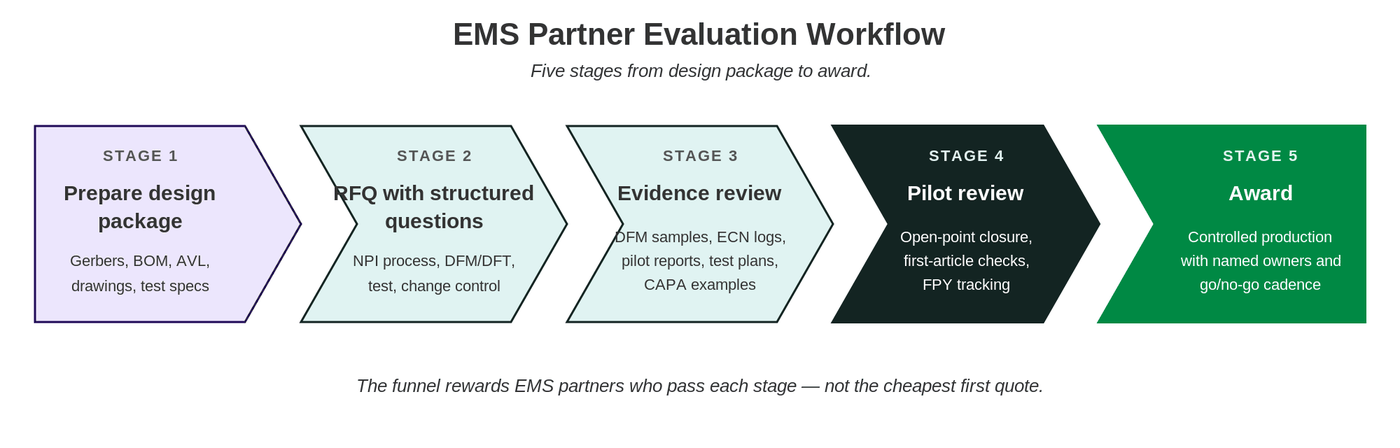
Use a structured scorecard rather than price, relationship comfort, or a factory presentation alone. It lets you compare partners on execution maturity instead of first quote.
What to Prepare Before Starting EMS Partner Evaluation
The partner carries responsibility, but a weak supplier package makes evaluation harder and invites bad assumptions. Before approaching partners, assemble: latest Gerbers and CAD data; a complete BOM with approved manufacturers and alternates where available; assembly and mechanical drawings with enclosure requirements; test, firmware-programming, and calibration requirements; labeling, serialization, and packaging requirements; compliance requirements; a forecast or expected build pattern; known design risks or unresolved engineering questions; revision history; quality expectations; and field-failure history if the product is already in production. Nothing has to be perfect — but known gaps should be visible. Hidden gaps are what create poor quotes, late surprises, and finger-pointing.
How Indic Fits the HMLV EMS Operating Model for Industrial Electronics Manufacturing
For HMLV programs, an OEM isn’t just buying capacity — it’s buying control over variation. That is the core of how Indic works: helping OEM teams move from design intent to controlled manufacturing execution through engineering-led NPI, DFM/DFT review before build, sourcing and component-risk escalation, test-strategy clarification with PCOLA-SOQ-style coverage thinking, FPY tracking through pilot and early production, change-control rigor, and pilot-build learning loops that feed the next build — backed by scalable India-based manufacturing and support across both US and India contexts. The discipline is underwritten by the systems that make it auditable: IATF 16949 and ISO 9001 quality management, ISO 27001 information-security controls that protect customer IP and design data, and serial-level traceability through the MES.
That discipline shows up most clearly where conditions are hardest. A first-batch mass-production transfer for an overseas lighting customer was set to begin with no end-of-line tester available — the kind of condition where a typical line either delays or ships against a softer inspection regime. Indic treated the pilot as an industrialization step rather than a shipment milestone: a cross-functional team took single-point ownership, layered process audits stood in for the missing end-tester, first-article checks were expanded, and findings from each early lot became specific updates to work instructions, inspection checkpoints, and operator notes before the next build. The first batch shipped with zero rejections and was accepted in full, and the program earned follow-on awards. The pilot didn’t just ship — it produced documented manufacturing learning that fed repeat-production discipline.
If your team is weighing an EMS transfer or pilot build, our companion guide on what to finalize before transferring a product to an EMS partner covers the readiness side of the same decision.
FAQ: EMS Partner Selection for High-Mix Low-Volume Electronics Manufacturing
What is high-mix low-volume electronics manufacturing? It means producing many product variants or assemblies in smaller quantities. It’s common in industrial electronics, instrumentation, control systems, IoT hardware, medical-adjacent devices, energy systems, and specialized OEM products.
Why is EMS partner selection harder for high-mix low-volume programs? Because the partner has to manage variation, engineering changes, sourcing uncertainty, test complexity, and documentation gaps. The challenge isn’t building the product — it’s controlling the program despite constant change.
Should OEMs choose the lowest-cost EMS quote? Not without understanding what’s included. A low quote may exclude the engineering, test, sourcing, and quality discipline the program needs. Compare total execution risk, not just unit price.
What is the most important EMS evaluation criterion? For HMLV programs, it’s execution discipline across NPI, DFM/DFT, sourcing, test, quality, and change control. No single capability is enough on its own.
When should an OEM involve an EMS partner? Ideally before the design is fully frozen, especially as the product moves toward pilot build or transfer. Early involvement surfaces manufacturability, testability, sourcing, and documentation risks before they become production problems.
What evidence should OEMs ask for when evaluating an EMS partner? Anonymized examples: DFM review formats, pilot-build reports, ECN/ECO logs, test plans, corrective-action examples, alternate-component approval records, and build traveler or work-instruction samples.
How should OEMs evaluate test strategy for low-volume builds? Ask how the partner balances Flying Probe, ICT, functional test, and manual or semi-automated test against fixture cost, coverage, debug value, and first-pass-yield learning during pilot and early production.
Choose the EMS Operating Model That Fits Your Program
High-mix low-volume electronics rewards discipline. The right partner controls complexity before it becomes cost, delay, or field risk — and you can see that capability most clearly in how a partner handles the uncomfortable details: incomplete transfer packages, unstable BOMs, test gaps, engineering changes, and pilot-build issues. Evaluate for that, demand the evidence, and you’ll be choosing a manufacturing partner rather than a board assembler.

Sign up to read this article