EV & Power Electronics
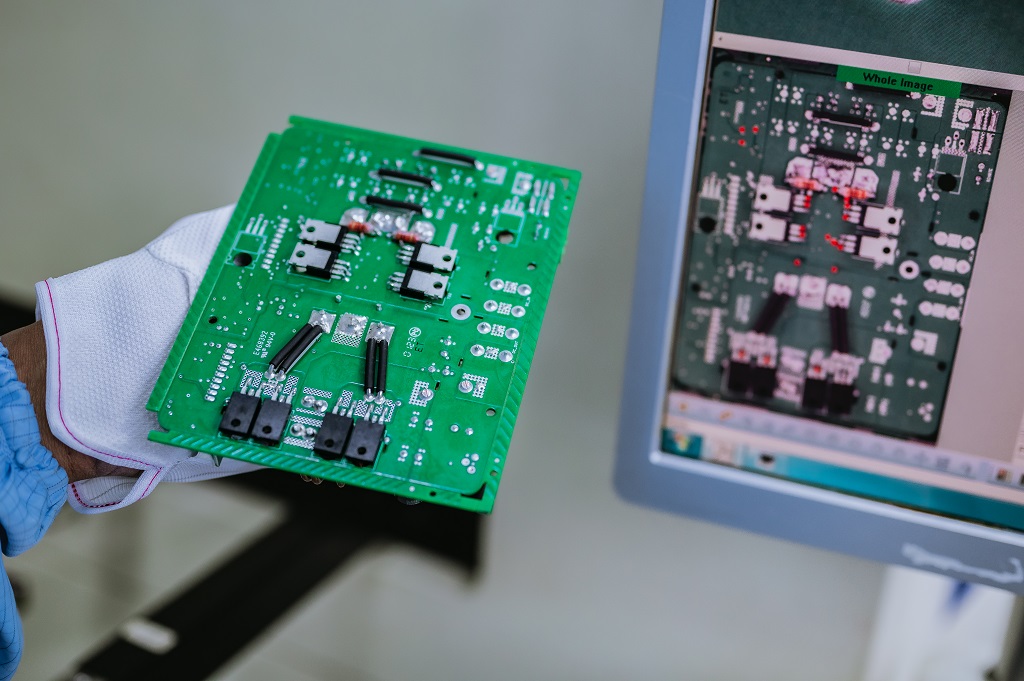
EV & Power Electronics: Throughput, ARIA Certification & Localization
EV charger manufacturing wins on throughput, ARAI certification readiness, and localization. INDIC accelerates builds with parallelized power electronics assembly(PFC/control/power boards + box-build), uses a test stack tuned for ICT/FCT/EOL with OBP programming on the line, and ships evidence with MES traceability. You hit certification dates without sacrificing yield.
Throughput in EV charger manufacturing: parallelize the critical path
- Split the flow. We process the PFC board, control board, and power board in parallel while box-build teams start enclosure prep and potting.
- Prioritize the bottleneck. We schedule power board assembly as the constraint step and stage inputs to prevent starving.
- Clone recipes. Once the first lane stabilizes, we clone fixtures/limits to a second lane to lift throughput without re-learning.
Result: We compressed a two-week charger build to a four-day assembly cycle, then delivered on Day 5.
Certification: ARAI readiness without rework
- Coverage plan for ARAI. Define ICT scope (opens/shorts/values), add boundary-scan/JTAG if access is tight, prove function at FCT, and hold EOL as the shipping gate.
- Safety evidence. Add hi-pot testing and insulation resistance where the product family requires it; store limits/results against the unit serial in MES traceability.
- Artifact pack. Lock golden unit, limit files, firmware checksum, and station logs; package them for the ARAI submission so certification doesn’t trigger redesign.
Localization: cost and lead time without quality drift
- Local inputs where viable. We localize enclosures, harnesses, and passive/standard parts while protecting risk components with AVL governance.
- One team, one record. The same program team runs build + test; MES traceability binds OBP version, test results, and pack data to the serial—clean evidence for audits and warranty.
- Measured impact. Full localization of charger manufacturing removed import dependency and enabled cost reduction alongside the compressed build cycle.
Test architecture for EV chargers: ICT/FCT/EOL with OBP on the line
- OBP programming on-line. Program MCU/SoC at the line; write version and checksum to MES against the unit ID; enforce no-pass/no-ship.
- Separate programming from testing. Don’t hold testers hostage to long flashes; keep testers focused on FCT/EOL coverage.
- Station health. Track fixture planarity, contact resistance, and instrument calibration on schedule; prevent intermittent escapes.
Case impact: By separating programming from testing, INDIC lifted tester throughput by 60%and cut direct test cost by 20% — with no new capital equipment.
Case evidence 1 — Four-day EV charger assembly cycle
- Problem. Certification required 10 units in five days; the existing process took two weeks.
- Method. Parallel PFC/power/control builds; early box-build start; potting and cable integration in parallel; fixtures/recipes cloned for a second lane.
- Outcome. Four-day assembly cycle, delivery on Day 5; localization in place to hold cost and lead time.
Case evidence 2 — EV charger testing: +60% throughput, −20% cost
- Problem. Single-station flow mixed programming with functional testing; long flashes throttled output.
- Method. Move OBP programming off the tester’s critical path; keep ICT/FCT/EOL focused on coverage.
- Outcome. Throughput +60%, cost −20%, fewer dependencies on external vendors.
What you provide; what INDIC returns
You provide: charger specs and ratings, BOM/AVL, Gerbers/stack-up, safety targets, firmware image + checksum rules, target quantities and date for ARAI certification.
INDIC returns: a charger coverage matrix(ICT/JTAG/FCT/EOL/hi-pot), OBP flow, parallelized build plan with lane cloning, localization plan (what to source locally, what to keep global), and an MES traceability schema with an evidence pack for certification.
Quick checklist — EV & power electronics throughput, certification, localization
- Parallelize PFC/control/power assembly; start box-build and potting early.
- Keep OBP programming off tester critical path; reserve testers for FCT/EOL.
- Define ICT/FCT/EOL coverage + hi-pot where required; bind all results to serial in MES.
- Clone fixtures/limits to scale throughput; track station health.
- Localize where stable; guard AVL for risk parts; maintain a certification artifact pack.
EV & Power Electronics: Throughput, ARIA Certification & Localization -The Bottom Line
To scale EV charger manufacturing, design the flow for throughput, build the test stack for ARAI certification, and localize without loosening controls. INDIC parallelizes assembly, separates OBP programming from FCT/EOL, and proves results through MES traceability—so you meet dates with predictable cost and quality.

Sign up to read this article