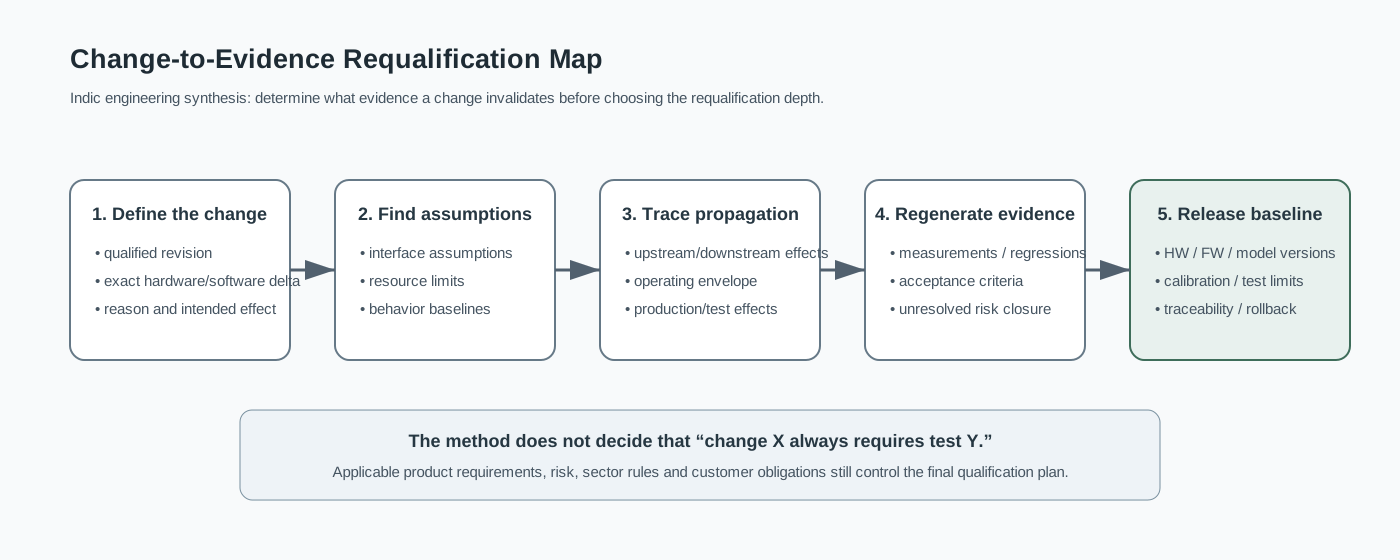
1. Define the changed baseline
Record the exact qualified revision and the exact delta. "New sensor" is not enough. The decision needs the old and new part, relevant configuration, calibration implications and reason for the change. "Firmware update" should resolve to an identifiable build and list of functions affected. A model revision should be tied to its model file/hash, quantization state, compiler/runtime context and intended performance change.
2. Identify the assumptions that may no longer hold
Ask which facts were taken as true when the current product was qualified. Did the model assume a specific sample rate or sensor range? Did the timing budget assume a particular operator map or memory configuration? Did thermal validation assume a certain sustained compute load? Did the production fixture assume a particular board access point or firmware handshake?
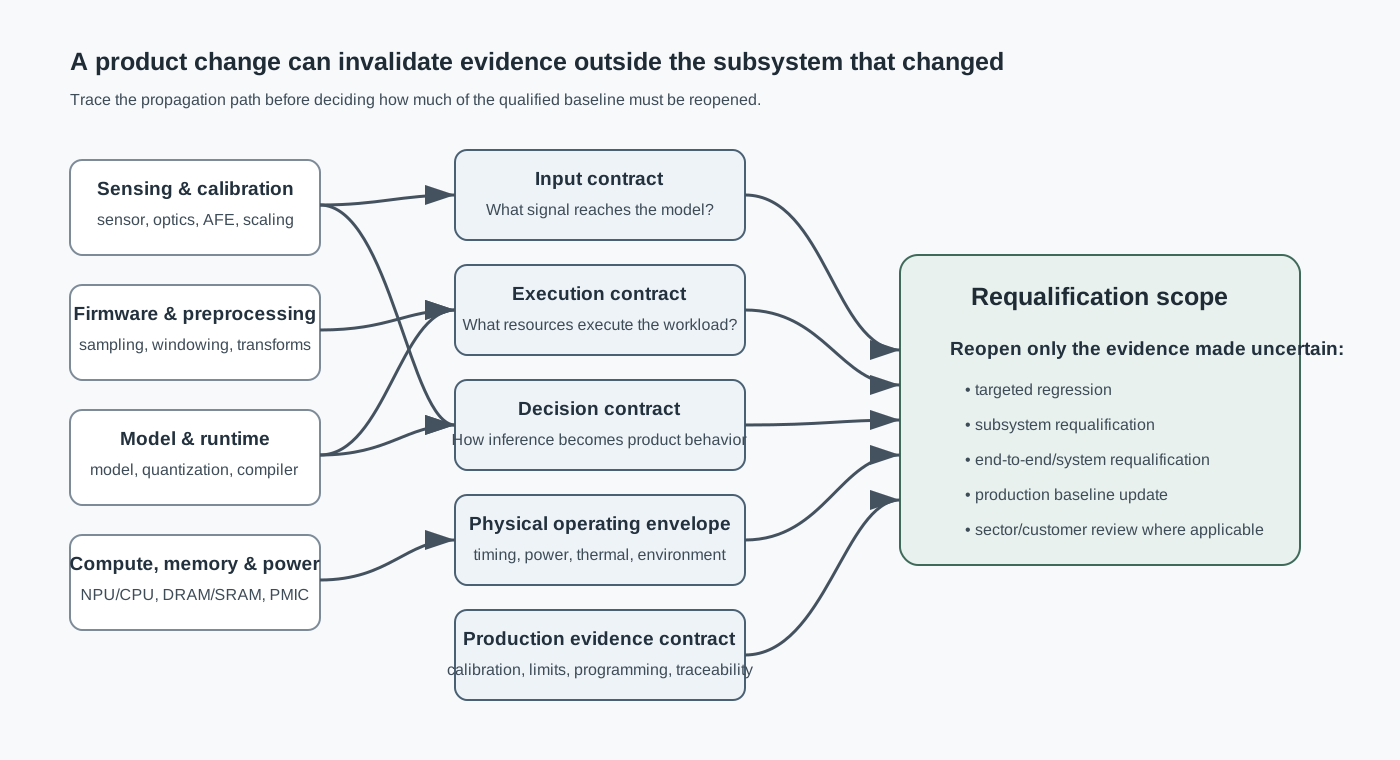
Requalification scope should follow the evidence invalidated by a change, not merely the subsystem where the change originated.
3. Trace the propagation path
Follow the change through the five contracts above. A sensor alternate may propagate into preprocessing, feature distribution and inference quality but have no material effect on memory. A model change may leave sensing untouched but alter memory bandwidth and latency. A mechanical enclosure change may not affect the BOM or firmware but can alter sensor coupling, acoustics, optics or sustained temperature.
4. Regenerate only the evidence needed to close the uncertainty
The appropriate result may be a targeted regression, subsystem requalification or broader end-to-end requalification. The choice depends on what the impact analysis reveals and on applicable product requirements. Evidence should be tied to an acceptance criterion that already exists or is deliberately revised; "test it thoroughly" is not an engineering closure condition.
5. Release a new controlled baseline
Once the affected evidence closes, release the configuration that was actually tested: hardware revision, BOM/AVL status, firmware build, model version/hash, calibration revision, runtime/compiler dependencies where material, test recipe and limit revision, and the effective manufacturing or field-release point. If rollback is part of the product strategy, the rollback configuration should be equally unambiguous.
What Should Be Reopened for Common Edge AI Product Changes?
The table below is intentionally not a mandatory test matrix. It shows the questions that commonly become relevant when a change can cross subsystem boundaries.
The distinction is important. A model-only change can become a hardware-validation change when it alters the device's execution contract. A hardware-only change can become an AI-validation change when it alters the model's input contract. Those are not reasons to retest everything. They are reasons to stop using organizational boundaries as substitutes for impact analysis.
When Is Targeted Regression Enough—and When Does the Scope Grow?
Targeted regression is appropriate when the team can show that the change is contained within known interfaces and the affected behavior can be demonstrated without reopening unrelated evidence. For example, a firmware defect fix in a logging path may require verification of that path without touching inference qualification if the executable change cannot affect timing, memory, preprocessing, model I/O or the acceptance logic relevant to the intelligent function.
The scope grows when one or more validated assumptions can no longer be bounded locally. That can happen when the change alters interfaces, pushes execution into a new resource regime, modifies representative input behavior, changes product decision logic, affects the physical operating envelope, or changes the conditions under which production test accepts a unit.
These are engineering scope descriptions, not universal compliance categories. Product-specific standards, customer requirements and regulatory obligations control the actual qualification plan.
Change Control Does Not End at Model Accuracy
Model accuracy is only one possible acceptance dimension. ST's current validation guidance explicitly distinguishes numerical correctness, real on-target inference time, memory and NPU/MCU behavior, and end-to-end application validation on real data. That distinction becomes particularly important after a change: a model can retain its task metric while execution behavior changes, or it can execute correctly while preprocessing or post-processing changes the product-level result.
The evidence selected for requalification should therefore match the mechanism being challenged. Depending on the change, that might include representative-data task metrics, conversion fidelity, p95/p99 timing, memory high-water mark, bandwidth, CPU/NPU utilization, power, rail transient behavior, temperature, calibration residuals, interface timing, fault behavior or production-test data. The article cannot provide universal pass limits because those limits belong to the product requirements.
NIST's AI RMF Manage playbook reinforces the lifecycle principle: post-deployment monitoring, testing/evaluation/validation/verification, updating and change management continue after deployment. It also explicitly calls for considering upstream and downstream consequences when AI systems or components are bypassed or deactivated. For Edge AI hardware teams, the practical interpretation is to keep the evidence chain connected to the controlled physical configuration rather than treating AI lifecycle and hardware lifecycle as separate records.
Component Qualification Is Not the Same as System Requalification
Supplier change notices are useful inputs, but they do not automatically close the OEM's system-level question. TI's product-change notification process includes anticipated impact on form, fit, function, quality and reliability together with qualification plans/results. NXP's change-management process similarly evaluates risk, qualification plans and success criteria before a change proceeds.
Those processes qualify the supplier's change against the supplier's product requirements. An Edge AI OEM still has to ask whether the component participates in a system assumption that the supplier cannot see. A sensor vendor can show that a new device meets its datasheet; only the product team can determine whether the new signal behavior is inside the model's validated input envelope. A memory vendor can qualify the memory device; only the system team can determine whether the new implementation preserves workload timing under the product's actual contention and thermal conditions.
Regulated Products May Require a Broader Change Plan
Some sectors impose explicit change-control and revalidation obligations. The important point is not to generalize one industry's rules to every Edge AI product. A useful example is the FDA's August 2025 final guidance on predetermined change control plans for AI-enabled device software functions. It asks manufacturers of applicable medical devices to describe planned modifications, the methodology used to develop, validate and implement them, and an impact assessment.
Sector boundary: FDA guidance applies to the relevant medical-device context. It is not a universal Edge AI requalification standard. Automotive, industrial, aerospace, consumer, energy and other products may have different regulatory, safety, customer and internal qualification requirements.
The broader engineering lesson is still useful: if changes are expected over the life of an intelligent product, defining the evidence strategy before each change arrives is more robust than improvising qualification after the design has already moved.
Production Test Must Follow the New Product Baseline
Requalification is incomplete if engineering proves the new configuration but manufacturing continues to test the old one. A change may require updates to programming files, configuration checks, calibration routines, acceptance limits, reference units, fixture interactions or traceability fields. Which items change depends on what the new revision actually modifies.
This is where Edge AI lifecycle control intersects with traditional industrialization discipline. Indic's published guidance on production test and traceability describes versioned recipes and limits, per-serial records, programming/version binding and evidence packs. Its DFx/DFM/DFT guidance likewise treats golden references and test limits as controlled production artifacts. Those are adjacent manufacturing disciplines rather than evidence of a specific Edge AI customer deployment, but the configuration-control principle carries directly into an intelligent-device release.
If the product configuration changes but the acceptance configuration does not, the factory may be proving the wrong thing.
The release package should therefore identify, where applicable, the effective hardware revision, approved BOM/AVL state, firmware build and checksum, model version/hash, calibration revision, test recipe and limit version, fixture/software revision, and the serial/lot/date from which the new baseline becomes effective. For products updated in the field, the same discipline should extend to update eligibility, staged release evidence, rollback configuration and observability.
What Evidence Should Exist Before the Changed Product Is Released?
A useful release review is less about the number of tests run than about whether the uncertainty created by the change has been closed. The following questions keep that review focused:
This gives the engineering team a defensible stopping rule. The aim is not to maximize test volume. It is to restore confidence in every product requirement that the change could reasonably have disturbed.
The Engineering Decision: Ask What Evidence Became Uncertain
Edge AI products evolve. Components go end-of-life, suppliers issue change notices, firmware defects are fixed, runtimes improve, models are retrained, calibration shifts and manufacturing processes mature. Treating every revision as a full restart is inefficient; assuming a local change has only local consequences is risky.
The more useful discipline is to preserve a controlled baseline and make requalification proportional to the evidence a change has invalidated. That is what turns change control from a paperwork exercise into an engineering decision.
When the next ECN, firmware build or model revision arrives, the first question should not be:
"How big is this change?"
It should be:
"Which part of our qualified evidence does this change make uncertain?"
Use the Edge AI Change-Impact & Requalification Matrix
The article explains the reasoning. The working matrix gives engineering, validation and NPI teams a structured place to record the changed baseline, affected contracts, required evidence, owners, closure status and the new released configuration—without imposing a universal change-to-test rule.
Request the Edge AI Change-Impact & Requalification Matrix
The worksheet is intended as an engineering review aid. Applicable product, customer, safety and regulatory requirements still govern the final qualification plan.