Supplier Quality in EMS: Audits, CAPA & PPM Turnarounds

Supplier Quality in EMS: Audits, CAPA & PPM Turnarounds

How to tell a closed CAPA from a documented one

By Pradeep Nelamangala and Gopikrishna Mamidipudi

Abstract: Supplier quality breaks down when a corrective action is documented before it is verified. This article explains how INDIC structures supplier audits, CAPA/8D, and PPM turnaround as one evidence system: containment by serial, root-cause replication, and effectiveness verification across multiple lots — not a single re-test. It draws on two INDIC programs, a first-batch delivery with no end-of-line tester available, and an automotive battery-management-system (BMS) flash failure that took PPM from roughly 5,000 to 0, to show what separates a CAPA that is actually closed from one that only looks closed on paper.

Executive Summary

Most EMS content treats supplier quality as a scorecard: certifications held, PPM trend, on-time delivery. Those numbers matter, but they answer a different question than the one an OEM quality engineer actually needs answered during an active issue: is this corrective action durable, or did the paperwork just catch up with an unresolved cause?

Two things are commonly missed. First, a defect's root cause can sit with the supplier (a component, a supplier process step) or inside the EMS's own process (fixture, test, assembly) — and those two situations call for different investigation paths, not the same generic "8D." Second, a PPM number is only as trustworthy as the lot/time window and defect definition behind it; a narrowed suspect range can make PPM look better without the underlying cause being fixed. This article works through both, using containment, root-cause, and verification evidence from two INDIC programs.

Why Supplier Quality and Audits Decide EMS Outcomes

An audit is really testing one thing: whether the process makes conformance the default outcome, not a result that depends on someone catching a problem manually. INDIC ties supplier quality to controls an auditor can actually inspect — layered process audits (LPA) at defined checkpoints, calibrated fixtures, versioned test limits, and MES traceability by unit serial. The point of tying it to serial-level records is specific: when an auditor asks what shipped and why, the answer should come from a log, not from someone's recollection of the build.

The PPM Turnaround Framework — and the Evidence Each Step Should Produce

INDIC runs CAPA/8D and PPM turnaround as a six-step sequence. The sequence itself is standard practice; what is often missing in how EMS partners describe it is what evidence should exist at each step before a reviewer accepts that the step is actually done.

  1. Containment. Quarantine the suspect lot and serialize the affected range in MES; any temporary limit relaxation requires written risk sign-off, not a verbal exception. Evidence to expect: a by-serial quarantine record and a signed risk waiver — not just a statement that "the lot was contained."
  2. Problem definition. Quantify the failure signature at the relevant test stage (ICT/FCT/EOL), capture photos and logs, and confirm the measurement system (GR&R/MSA) before drawing conclusions about the cause. Evidence to expect: a defined failure signature with a confirmed measurement system, not an assumption that the test result itself is trustworthy.
  3. Root-cause. Run 5-Why or Ishikawa analysis across design, process, test, and supplier inputs, and replicate the failure on a golden setup. Evidence to expect: a reproduced failure under controlled conditions and a named mechanism — "component defect" or "process variation" is not a terminal root cause; the mechanism has to be specific enough to act on.
  4. Corrective action. Define the fixture, code, DFT, or DFM change; update work instructions and limits; train operators; disposition affected material through MRB. Evidence to expect: a documented change tied to the named root cause, not a downstream workaround that only masks the symptom.
  5. Verification. Re-run affected lots and confirm the improvement at station and line level by trending FPY/PPM. Evidence to expect: a trend across several subsequent lots, not a single passing re-test. A corrective action that has not been observed across more than one lot has not yet demonstrated it is durable.
  6. Control plan. Lock recipes and limits, add LPA questions that would catch a regression, schedule re-audits, and push the learning upstream into supplier scorecards and PPAP/APQP documentation where applicable. Evidence to expect: an updated control document and a scheduled re-audit date, not just a closed ticket.
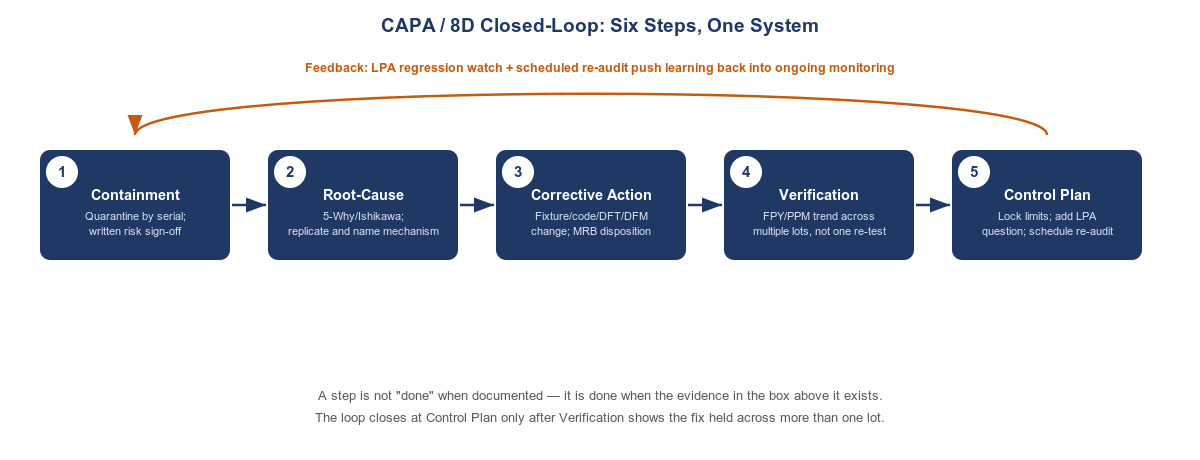
CAPA closed-loop diagram showing five steps in sequence — Containment, Root-Cause, Corrective Action, Verification, Control Plan — with a feedback arrow from Control Plan back to Containment representing ongoing LPA regression watch and scheduled re-audits.
Figure 1 — A CAPA step is not done when documented; it is done when the evidence in that step exists. The loop closes at Control Plan only after Verification shows the fix held across more than one lot.

Supplier-Caused vs. EMS-Process-Caused Escapes: Why the Distinction Changes the Investigation

Not every quality escape has the same kind of cause, and treating them all as one generic "8D" can send the investigation in the wrong direction. A defect can originate upstream — in a component or a supplier's own process — or it can originate inside the EMS's assembly, test, or fixture process. The evidence needed to prove each is different, and so is the party that owns the fix.

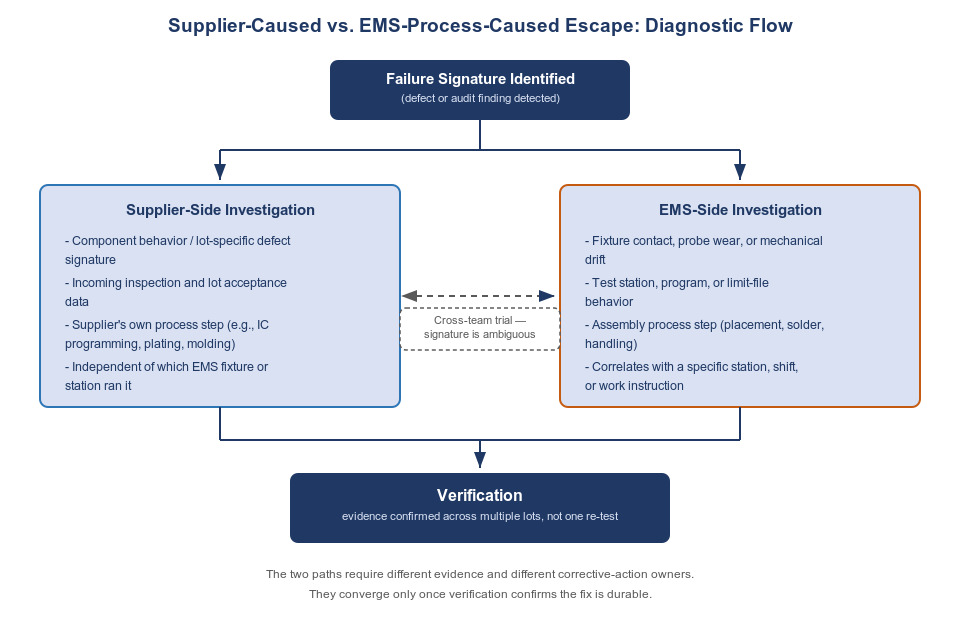
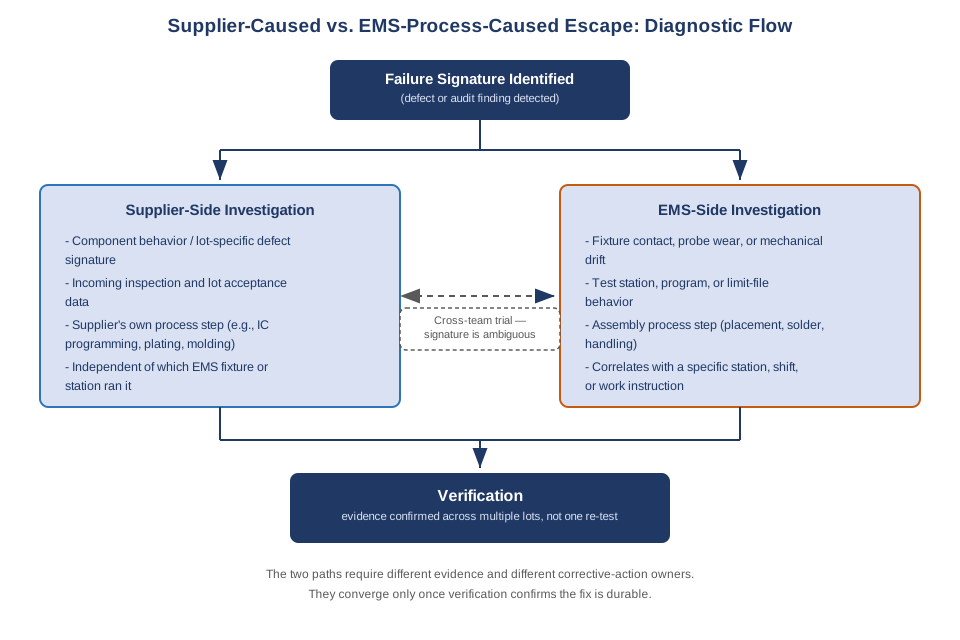
Diagnostic flow diagram showing a failure signature branching into a supplier-side investigation path (component behavior, incoming inspection, supplier process step) and an EMS-side investigation path (fixture, test station, assembly process), connected by a cross-team trial step where the signature is ambiguous, and converging at a shared verification step.
Figure 2 — Supplier-caused and EMS-process-caused escapes require different investigation paths that converge only at verification.

A supplier-side cause typically shows up as a defect signature tied to a specific component or lot, independent of which fixture or test station ran it. An EMS-side cause typically correlates with a specific fixture, test station, work instruction, or shift, regardless of which supplier lot was used. When the signature does not cleanly point one way, a cross-functional trial — pulling in the supplier, the test-equipment side, and design — is what actually isolates it, rather than assigning the investigation to whichever team happens to own the ticket.

Case Evidence 1 — First-Batch Delivery With No End-of-Line Tester Available: Zero Rejections

Problem. A new overseas lighting customer required a first production batch shipped before the end-of-line tester was available — a real escape-risk situation on a brand-new relationship, with no final functional gate in place.

Action. INDIC added layered process audits at critical points, expanded first-article checks per station, enforced IPC-A-610 inspection criteria, and tightened kit integrity. Every step wrote to MES with operator and tool IDs attached.

Result. Zero rejections on the batch, with the customer relationship continuing afterward. The mechanism worth noting: LPA and expanded first-article inspection provided additional controls that mitigated the risk created by the missing end-of-line test gate, because the evidence existed per serial rather than as a general assurance that "quality was watched closely."

The full case detail is documented separately: see the complete first-batch delivery case study.

Case Evidence 2 — Automotive BMS PCBA Flash Failure: An IC-Associated Failure Requiring Cross-Team Isolation

Problem. An automotive battery-management-system (BMS) PCBA program showed a high fail rate tied to one IC's flash operation. The customer could not share the IC's code with the supplier, and the supplier declined to investigate further without it; the supplier's own analysis had found no issue with the IC itself. Quarantined boards accumulated while yield and floor space were both affected.

Action. Rather than assuming where the cause sat, INDIC ran cross-team trials with the tester vendor, the production team, and design to validate the assembly process — the diagnostic split described above, applied in practice. Those trials ruled out assembly-process causes. With process cleared and the supplier's own analysis inconclusive, the software team developed a workaround to fix the flash failure in that IC, validated it on the quarantined units, separated on-board programming (OBP) from test to speed up cycle time, and logged every pass in MES.

Result. INDIC's published case reports PPM falling from roughly 5,000 to 0, with no failures reported on units shipped after the software upgrade as of the case study's writing; test flow stabilized and quarantine floor space was recovered. This case illustrates the diagnostic split in a realistic, imperfect form: once EMS-side assembly and process causes were ruled out through cross-team trials, the fix was found and verified on the EMS side — without the supplier ever confirming a defect in the component itself. That is a common, honest outcome of this kind of investigation. The evidence supports that assembly-process causes were eliminated and that a software change resolved the observed failure; it does not, on its own, prove the component supplier caused the defect, and the case should not be read as establishing that.

The full case detail is documented separately: see the complete BMS flash-failure case study.

Why a Low PPM Number Can Still Mislead

A common assumption is that low PPM proves supplier quality is under control. That holds only when the PPM figure is computed over a stable, clearly defined lot or time window with a consistent defect definition and an adequate sample size.

It breaks down in two common ways. First, in low-volume or high-mix production, a single lot can swing a PPM figure sharply — a good or bad batch is not the same thing as a controlled process. Second, after containment, a supplier or EMS can narrow the suspect date or lot range under investigation; doing so can mathematically improve the reported PPM without the underlying cause actually being eliminated. Neither of these means the reported number is dishonest — it means the number alone does not answer the question a reviewer actually needs answered.

The practical check is the same one built into the framework above: confirm the measurement system before trusting the metric, and look for a trend across multiple lots after the fix rather than a single improved figure. If the root-cause statement names a specific mechanism ("flash routine timing on IC X under condition Y") rather than a general category ("component defect resolved"), that is a reasonable signal the investigation went deep enough to support the number.

Audit & Documentation Package — What Auditors Will Ask For

  • Trace set: by-serial logs across ICT/FCT/EOL/OBP, fixture IDs, recipe and limit-file versions, and operator certification records.
  • CAPA/8D file: problem statement, supporting data, root-cause analysis, corrective actions taken, verification runs, and the locked control plan.
  • Where applicable: PPAP/APQP artifacts (PFMEA, process flow, control plan), inspection records, and calibration history.

Reading the Evidence: A Stage-by-Stage Reference

CAPA StageEvidence a Reviewer Should Ask ForWeak Substitute to Watch For
ContainmentBy-serial quarantine record; written risk sign-off for any limit relaxationA verbal assurance that the lot was "pulled" with no serial-level record
Root-causeReproduced failure on a golden setup; confirmed measurement system (GR&R/MSA); a named mechanism"Component defect" or "process variation" with no specific mechanism identified
Corrective actionA documented change tied directly to the named root cause; MRB disposition of affected materialA downstream inspection or test-station workaround that catches the symptom without changing the cause
VerificationFPY/PPM trend across multiple lots following the fixA single passing re-test presented as proof the issue is resolved
Control planLocked recipe/limit versions; new LPA question; scheduled re-audit date; supplier scorecard updateA closed ticket with no update to the standing control documents

Reading a PPM Signal

SignalPossible InterpretationWhat to Ask
PPM improves immediately after containmentMay reflect a genuinely fast fix — or a narrowed suspect-lot definitionWhat was the suspect-lot/date range before and after containment, and did the definition change?
PPM improves after one corrective-action cycleMay be a durable fix — or a single good lotHow many lots have been run since the corrective action, and is the improvement holding across all of them?
Root-cause statement is broad ("component issue," "process drift")Investigation may not have reached a specific, actionable mechanismWhat is the specific mechanism, and how was it reproduced?

What You Provide; What INDIC Returns

You provide: a defect definition, acceptance criteria, the suspect date/lot range, and known constraints such as code access limitations or safety limits. These matter because containment and root-cause work depend on a clear starting definition — a vague defect description slows containment and can misdirect the root-cause investigation from the outset.

INDIC returns: a PPM turnaround plan (containment → root-cause → corrective action → verification), updated test coverage across ICT/JTAG/FCT/EOL, revised work instructions and limits, and an audit pack exported from MES traceability.

Quick Checklist

  • Quarantine and serialize immediately; do not debate root cause before containment is in place.
  • Confirm the measurement system (MSA/GR&R) before chasing causes.
  • Determine whether the escape is supplier-caused or EMS-process-caused before assigning the corrective action owner.
  • Require a multi-lot verification trend, not a single re-test, before accepting a CAPA as closed.

For a full working version of this review process — with fields to capture evidence and assign owners at each stage — see the gated worksheet below.

FAQ

What does it mean for a CAPA to be closed in EMS manufacturing?

A CAPA is closed when the corrective action's effectiveness has been verified — with evidence that the failure mechanism has been controlled or eliminated across multiple production lots or a defined time window — not merely when the corrective action has been documented and implemented.

Why can a low supplier PPM number still be misleading?

PPM is sensitive to the lot/time window and defect definition used to calculate it. A narrowed suspect range, or a small sample in low-volume production, can lower the reported PPM without the underlying cause being fixed.

What is the difference between a supplier-caused and an EMS-process-caused escape?

A supplier-caused escape traces to a component or a supplier's own process step, independent of which EMS fixture or station ran it. An EMS-process-caused escape correlates with a specific fixture, test station, or work instruction. The two require different investigation paths and different corrective-action owners.

What should an OEM ask for before accepting a supplier or EMS CAPA as closed?

A by-serial containment record, a reproduced and named root-cause mechanism, a corrective action tied directly to that mechanism, and a verification trend across more than one lot.

Closing Perspective

Supplier quality improves when audits and CAPA reviews are built to demand proof rather than accept a narrative. The evidence that actually distinguishes a closed issue from a documented one is specific: containment by serial, a root cause reproduced and named rather than assumed, and a verification trend observed across more than one lot. INDIC runs its own PPM turnarounds against that standard — hard containment, reproducible root-cause work, and MES traceability that holds up when an auditor asks for it. This same evidence standard is worth applying when evaluating an EMS partner beyond unit price.

Download the Supplier CAPA & Audit Evidence Review Worksheet — a working template for reviewing containment, root-cause, corrective-action, and verification evidence in an active supplier-quality issue or audit.

Close
After signing up the PDF will be emailed to you at the address you provide.  Please use a company address - gmail, yahoo, outlook, etc. will not be accepted.
Thank you! Your submission has been received!
Oops! Something went wrong while submitting the form.
Join us to stay updated with our latest blog updates, manufacturing and assembly trends, news and announcements!
Thank you! Your submission has been received!
Oops! Something went wrong while submitting the form.